Disclosure: This post contains affiliate links. If you book through our links, we may earn a small commission at no extra cost to you. Thanks for supporting Faceted Travel!
Table of Contents
There is a forest in the southeast corner of Bosnia and Herzegovina that has never been logged. Not lightly logged, not selectively managed, never cut. Perucica has been left alone for so long that some of the beech and fir trees in it are older than the United States, and standing under them is one of the strangest and quietest experiences we have had anywhere in Europe.
Sutjeska is Bosnia’s oldest national park and by some distance its least visited good thing. It holds the country’s highest mountain, one of Europe’s last two primeval forests, a seventy five meter waterfall most people have never heard of, and a concrete war memorial so aggressively brutalist that it has its own architectural fan club. On the day we drove in, we passed two other cars. If you have been reading our Bosnia posts and wondering where the country keeps its wilderness, this is the answer.
Why Sutjeska Is Worth the Detour
Let us be upfront: Sutjeska is not on the way to anywhere. It sits on the Montenegrin border, about two and a half hours south of Sarajevo on the road to Niksic, and adding it to a trip costs you a full day minimum, realistically two. Here is what you get for that.
Perucica primeval forest. About 1,400 hectares of untouched old growth, a strict reserve, roughly a third of the remaining primeval forest in Europe. Trees up to fifty meters tall and three hundred years old. You cannot walk in unaccompanied, which is the reason it still exists.
Maglic, 2,386 meters. The highest peak in Bosnia and Herzegovina, a genuine pyramid of a mountain sitting right on the border, climbable in a long day by anyone comfortable with steep scree and a little scrambling.
Skakavac waterfall. Seventy five meters, dropping off a cliff inside the Perucica valley. Not the more famous Skakavac near Sarajevo. This one is bigger and almost nobody sees it up close.
The Valley of Heroes memorial. Two enormous concrete wings marking the 1943 Battle of the Sutjeska, one of the defining engagements of the Yugoslav partisan war. It is a striking piece of architecture and an unavoidable piece of history.
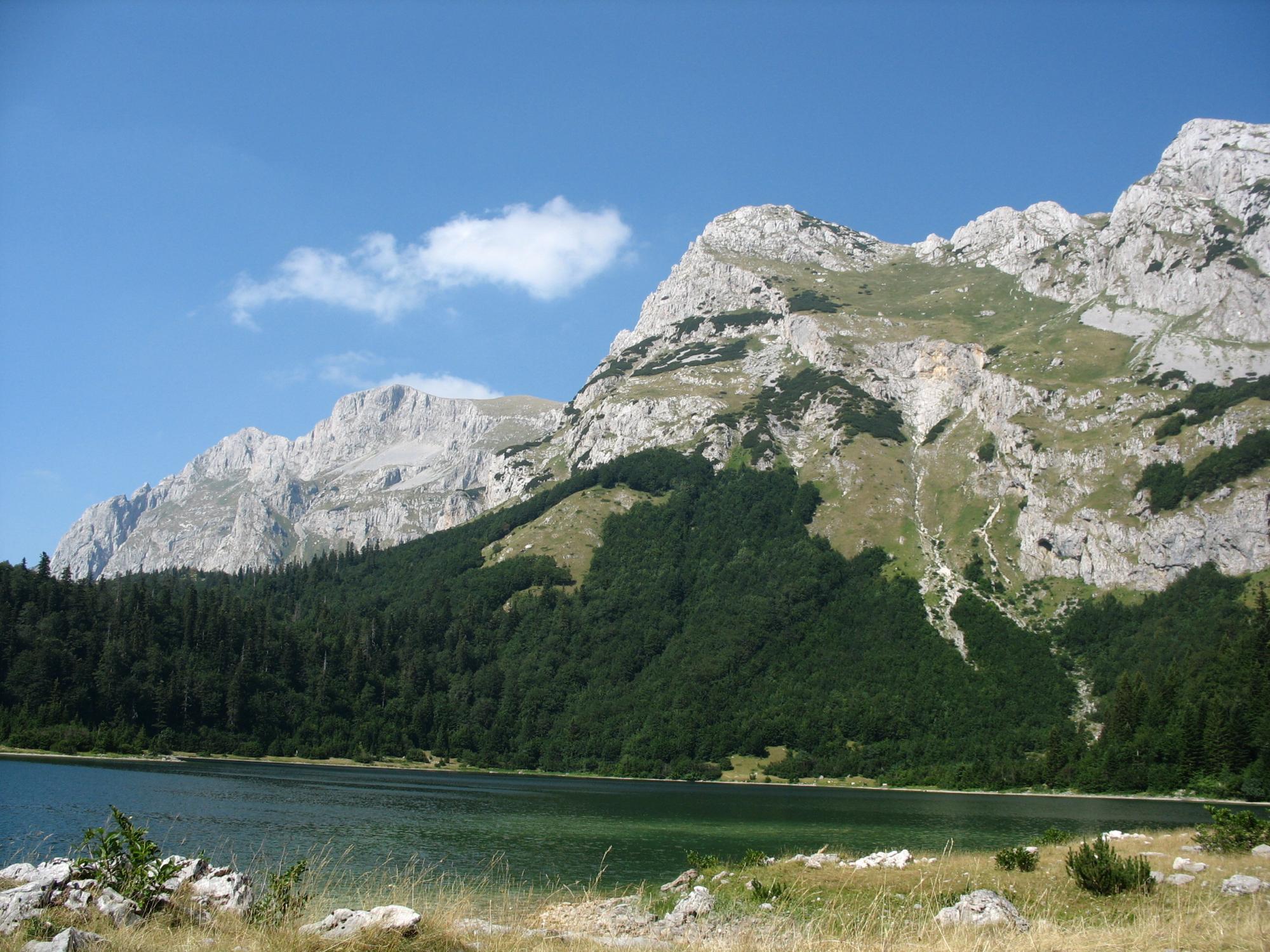
Trnovacko lake. A heart shaped glacial lake under a wall of limestone that is technically just over the Montenegrin border but is reached from the Sutjeska side and is the single most photographed thing in the region.
Getting There and Getting Around
The park entrance and visitor centre are at Tjentiste, on the M20 road between Foca and Gacko. From Sarajevo it is about 130 km and two and a half hours, mostly on decent two lane road through the Drina valley. From Mostar it is roughly four hours. From Niksic in Montenegro, about an hour and a half.
You want a car. There is a bus that runs the Sarajevo to Niksic route and will drop you at Tjentiste, but once you are in the park the trailheads and viewpoints are spread over a lot of ground with no internal transport, and you will spend your visit walking road instead of trail. If you are already building a loop, we fold Sutjeska into the southern leg in our Bosnia and Herzegovina road trip itinerary.
The road up to the Prijevor saddle, the trailhead for both Maglic and Trnovacko lake, is a rough gravel track. A normal hatchback will make it in dry conditions if you drive slowly and do not mind the noise. After heavy rain you want clearance. Ask at the visitor centre, they will tell you honestly.
Entry to the park is around 5 KM per person plus a small vehicle fee. Bring cash.
Perucica: You Need a Guide, and That Is the Point
Perucica is a strict nature reserve. Independent entry is not allowed, and this is not a rule that exists to sell tours. It exists because the forest has survived precisely by not having a path network and a stream of visitors in it.
Guides are arranged at the park visitor centre at Tjentiste or through Hotel Mladost. Book at least a day ahead in summer, and further out in July and August. Expect somewhere in the region of 60 to 120 KM for a group depending on length and whether you want the full Skakavac descent. Confirm price and duration before you set off.
There are two standard options.
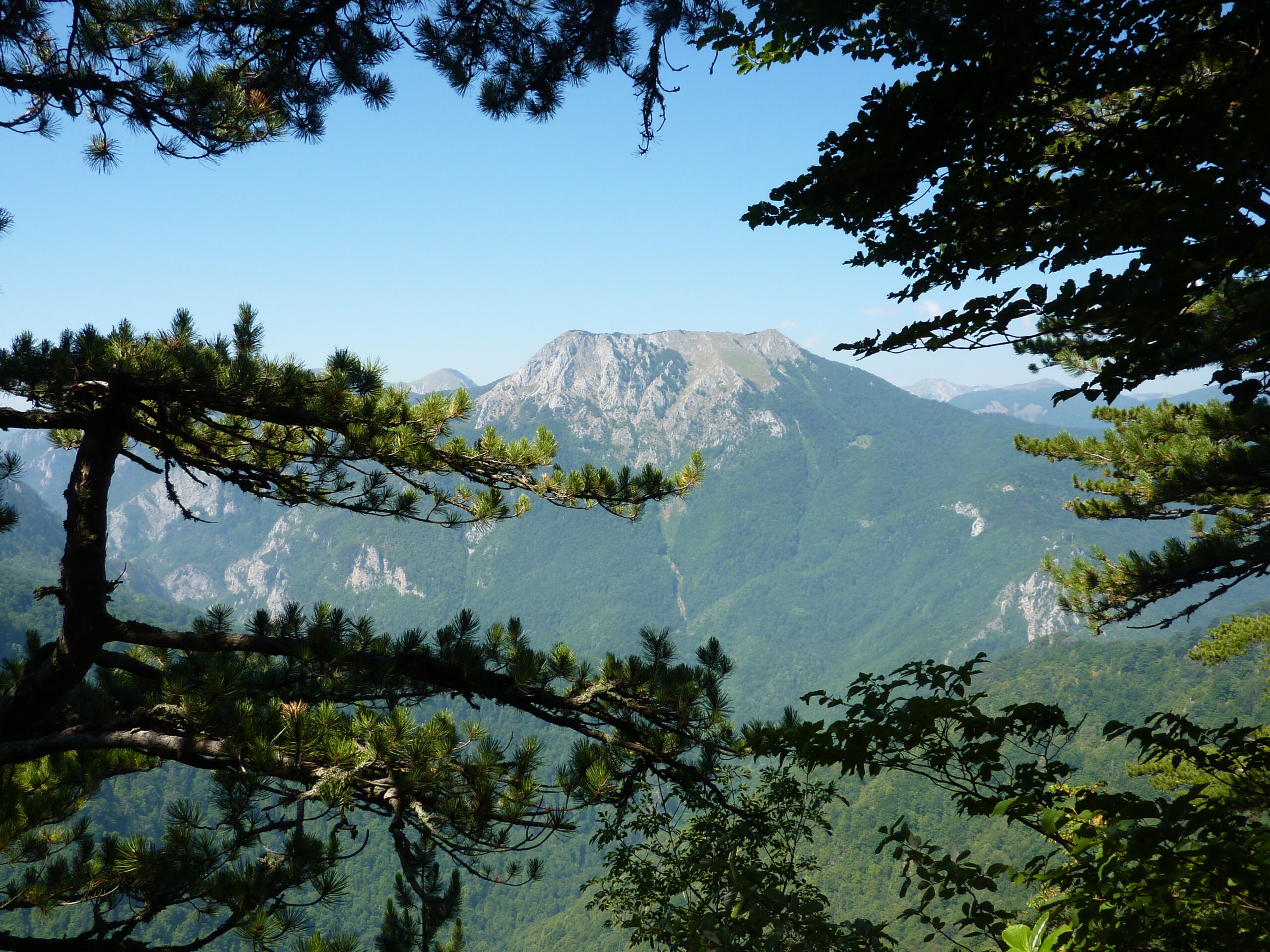
The viewpoint walk takes you to Dragos sedlo, a balcony above the valley where you look down over the entire forest canopy with Skakavac waterfall dropping off the far wall. It is short, mostly easy, and it gives you the scale of the thing. Two to three hours.
The descent into the valley floor goes down among the old growth itself, which is where it stops being scenery and starts being something else. The light goes green. There is almost no undergrowth because the canopy is so complete. Enormous fallen trunks are left exactly where they came down, slowly turning back into soil, with new firs growing out of them. It is quiet in a way that managed forest never is. Five to six hours, and moderately strenuous on the way back up.
If you take one, take the second.
Climbing Maglic
Maglic is the highest point in Bosnia and Herzegovina at 2,386 meters, and it is a properly good mountain: a steep limestone pyramid with the Montenegrin border running over the summit.
The normal route starts from the Prijevor saddle at about 1,650 meters, reached by that gravel road. From there it is roughly three to four hours up and two and a half to three down, with around 750 meters of ascent. The first section is a pleasant enough climb through scrub and meadow. The upper section is steep scree and a few short rocky steps where you will want your hands. There is a via ferrata style cable on one passage. It is not technical climbing, but it is not a walk either, and it is genuinely exposed in places.
Things we would tell anyone going up:
- Start early. Afternoon thunderstorms build fast over these mountains in summer and you do not want to be on the scree in one. Be off the summit by 1pm.
- The summit is on an international border. In practice nobody cares and there is no infrastructure, but you should have your passport in your pack.
- There is no water on the route. Carry two liters minimum, three in heat.
- Mist is the real hazard. Maglic means “the foggy one” and it earns the name. Cloud can come in within twenty minutes and the descent route across the scree is not obvious in poor visibility. Download an offline map and have a phone with battery.
- Go with a guide if you are not an experienced hiker. The park can arrange one, and it is a reasonable use of money on a mountain where the descent is the hard part.
If the summit is more than you want, the walk from Prijevor down to Trnovacko lake is the alternative and it is spectacular in its own right. About ninety minutes down, two hours back, through a hanging valley to a green heart shaped lake under a thousand meter limestone amphitheatre. Technically you have crossed into Montenegro, which nobody checks and nobody minds, but again, carry your passport.
The Valley of Heroes and the Battle of the Sutjeska
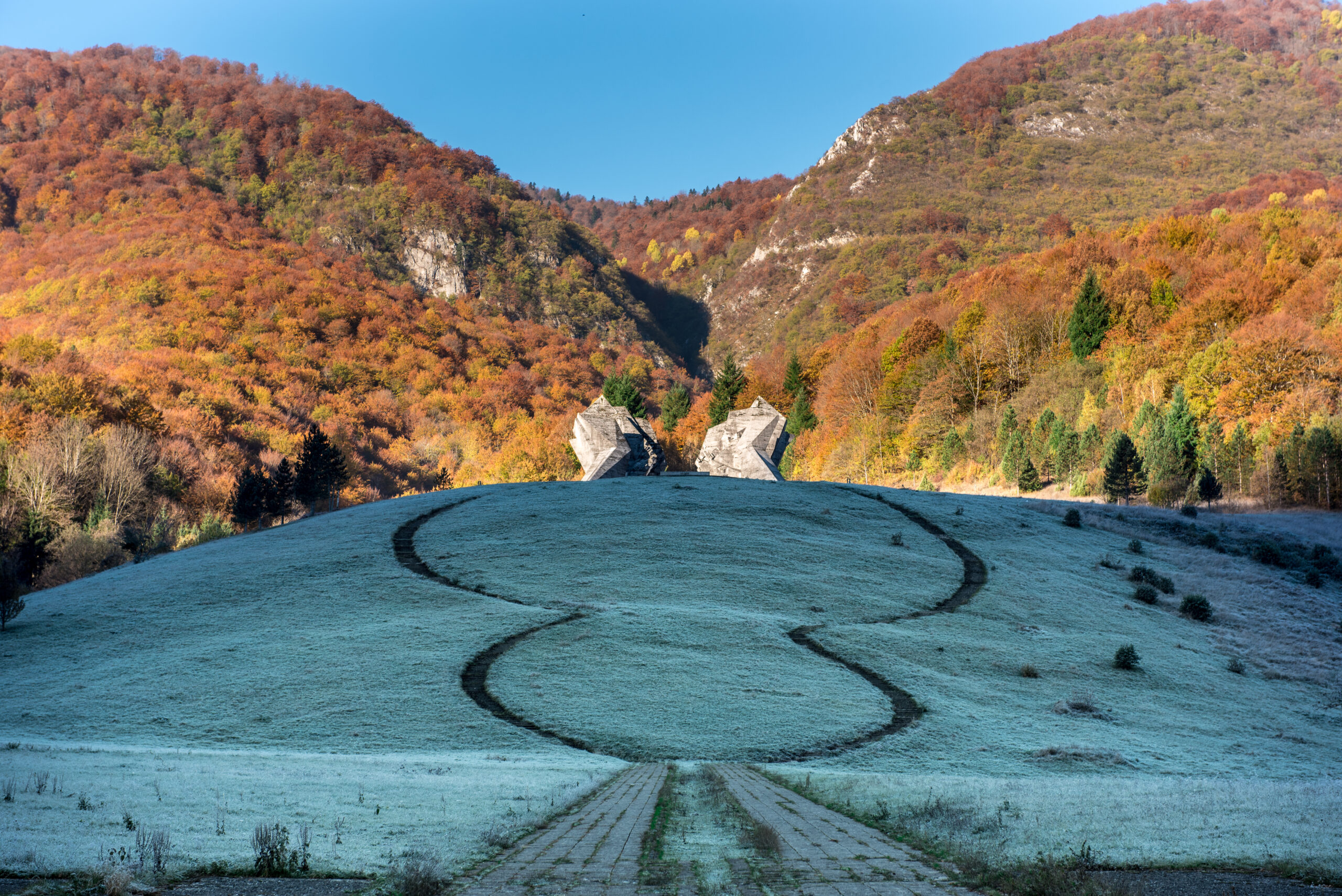
At Tjentiste, on a grassy slope, two curved concrete slabs stand about twenty meters tall and lean away from each other like a gate. This is the Sutjeska memorial complex, finished in 1971, designed by Miodrag Zivkovic, and it marks the Battle of the Sutjeska in May and June 1943.
The short version of the history: around 18,000 Yugoslav partisans, encircled by a much larger German led force, fought their way out through this valley over five weeks. Roughly a third of them died, including most of the wounded who could not be carried. It is the battle that turned the partisan movement into the force that ended up running postwar Yugoslavia.
The memorial is worth twenty minutes even if you have no interest in the history, because it is one of the best surviving examples of the Yugoslav modernist monument style. There is also a small memorial house nearby with frescoes and a museum, though opening hours are erratic.
We would not skip it. Bosnia’s twentieth century is inescapable when you travel here, and we have written about approaching that thoughtfully in our guide to whether Bosnia and Herzegovina is safe, which covers rather more than the title suggests.
Where to Stay
Options are limited, which is part of the charm and part of the planning problem.
Hotel Mladost at Tjentiste is the main base inside the park. It is a large socialist era hotel, partly renovated, unglamorous, well located, and the staff are the best source of information about trail and road conditions. They can arrange Perucica guides.
Bungalows and eco camps around Tjentiste offer simple wooden cabins, usually with shared or basic facilities, and several have restaurants. Good value, and better atmosphere than the hotel if you do not need comfort.
Foca, forty minutes north, has more choice and is the rafting base for the Tara and Drina rivers. If you want to combine Sutjeska with a rafting day, stay here.
Wild camping is not permitted inside the park, but there is a designated campsite near the visitor centre.
Two nights is the right amount: one full day for Perucica and the memorial, one for Maglic or Trnovacko lake.
When to Go
June to September is the season, and that is not really negotiable for the high ground. July and August are warm and reliable but bring afternoon storms. Late June and early September are our pick: stable weather, everything open, and you will still have trails largely to yourself.
May is beautiful in the valley with the forest coming in and the rivers high, but there is often snow on Maglic into early June and the Prijevor road may be impassable.
October turns the beech forest gold and is stunning, but guides are harder to arrange and the weather is a coin flip.
November to April, most of it is effectively closed. The park does not operate as a winter destination and access to the high ground is for equipped mountaineers only.
For how this fits the rest of the country, see our best time to visit Bosnia and Herzegovina guide.
What It Costs
Sutjeska is cheap even by Bosnian standards. Park entry is a few marks. A bungalow runs 40 to 80 KM a night for two. Dinner at Hotel Mladost or a local restaurant is 15 to 25 KM a head. The guided Perucica walk is the main expense, and split across a group it is modest.
Budget roughly 150 to 250 KM per person for two nights including a guided forest walk, which is remarkable for what you get. Our full Bosnia and Herzegovina cost breakdown puts that in context against the rest of the country.
Where to Book
- Accommodation: Search Tjentiste and Foca stays on Booking.com. Inventory is thin, so book ahead in July and August. Foca has considerably more listings if Tjentiste is full.
- Guided hikes and rafting: Browse Bosnia outdoor tours on Viator. For Perucica specifically, booking direct through the park visitor centre is usually cheaper and always better informed.
- Car rental: Pick up in Sarajevo. Confirm the vehicle is permitted on unpaved roads and check the cross border card if you are continuing into Montenegro.
Our Honest Take
Sutjeska asks more of you than anywhere else in Bosnia. It is a long drive, the infrastructure is thin, the best thing in it requires a guide and a phone call a day ahead, and you cannot do it as a day trip from anywhere useful.
It is also the only place in the country where we felt like we were somewhere genuinely wild rather than somewhere lovely and lightly used. Standing at the bottom of Perucica, under trees that were there before the Ottomans left, with Skakavac going somewhere out of sight, we were not thinking about the drive.
Building out a Bosnia trip? Our Sarajevo travel guide covers the obvious starting point and is the closest city to Sutjeska. If you want more Bosnian nature, Una National Park and Bihac does the same job in the northwest with far easier access. And for the practical groundwork, read how to plan a trip to Bosnia and Herzegovina.