Disclosure: This post contains affiliate links. If you book through our links, we may earn a small commission at no extra cost to you. Thanks for supporting Faceted Travel!
Table of Contents
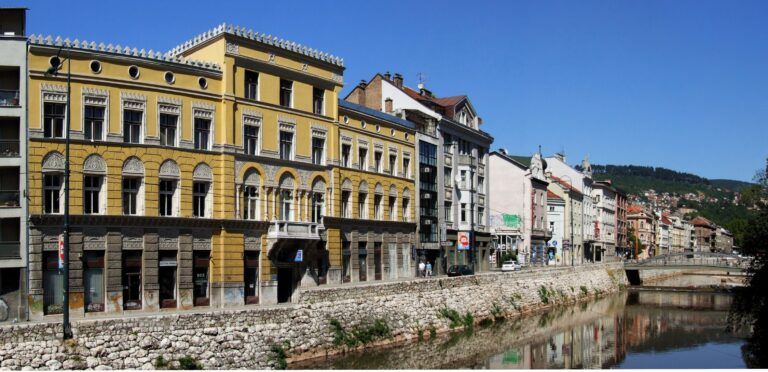
There is a spot in the middle of Sarajevo where you can stand with one foot on Ottoman cobblestones and the other on an Austro-Hungarian pavement, and the two halves of the city meet in a line under your shoes. They have marked it, because everyone stops there anyway. It is the single best summary of Sarajevo we can give you: this is a city where four empires, three religions, and one very difficult recent war are all stacked on top of each other within about ten walkable minutes.
Sarajevo is not a pretty city in the way that Dubrovnik or Ljubljana are pretty. It is far more interesting than that. It is the most underrated capital in Europe as far as we are concerned, and it is also one of the cheapest, which is a combination that does not come up often.
Why Sarajevo Should Be on Your List
Three reasons, and they build on each other.
First, the layering. Within a few hundred yards you have a 16th century Ottoman bazaar, a Catholic cathedral, a Serbian Orthodox cathedral, a synagogue, and one of the largest mosques in the Balkans. The nickname is the Jerusalem of Europe, and unlike most city nicknames it is accurate rather than marketing.
Second, the history. This is where Archduke Franz Ferdinand was assassinated in 1914, which started the First World War. It is where the 1984 Winter Olympics were held. And it is where the longest siege of a capital city in modern warfare lasted 1,425 days, from 1992 to 1996. All three are still visible on the streets.
Third, and this is the part that surprises people, Sarajevo is fun. The cafe culture is serious business, the food is excellent and absurdly cheap, and the city has a young, warm, funny energy that has nothing to do with any of the heavy history.
If you are already planning time in the region, Sarajevo pairs perfectly with Mostar two hours south and works as an inland counterweight to a coast-heavy trip through Croatia or Montenegro.
Getting to Sarajevo
By air. Sarajevo International (SJJ) is small, about a fifteen-minute drive from the center, and served by Austrian, Turkish, Lufthansa, Pegasus, Wizz Air, and a handful of others. There are no direct flights from North America, so you will connect through Istanbul, Vienna, Munich, or Zagreb. Fares are usually reasonable if you are flexible, and our cheap flights guide covers the search strategy we actually use.
By bus. Buses connect Sarajevo with Mostar (2.5 hours), Dubrovnik (6 hours), Split (7 hours), Belgrade (7 hours), and Zagreb (8 hours). The main station is a short tram ride from the center. There is also an East Sarajevo station serving mostly Serbian routes, so double check which one your ticket uses.
By train. The Sarajevo to Mostar line is the one to take. Two hours through the Neretva gorge, and genuinely one of the better scenic rail rides in Europe for the price. Schedules are limited, usually two departures a day, so check before you count on it.
By car. Driving in is easy, driving inside Sarajevo is not. The old center is pedestrianized or extremely tight, and parking is a chore. If you are on a road trip, park it at the hotel and leave it there.
Where to Stay in Sarajevo
Bascarsija and the old town. This is where we would stay on a first visit. You are inside the Ottoman quarter, everything is walkable, and the atmosphere in the evening is the reason you came. Small guesthouses and boutique hotels dominate, and 50 to 90 euros gets you something genuinely nice.
Ferhadija and the Austro-Hungarian center. A five-minute walk west, slightly more polished, slightly quieter at night, with the bigger hotels and better cafes. Good compromise.
Marijin Dvor and the business district. Modern hotels, better value, near the History Museum and the Holiday Hotel where the war correspondents stayed. Fine if you want space and a gym, a bit soulless otherwise.
Up the hills. Guesthouses on the slopes above town have incredible views over the valley. Beautiful, cheap, and a serious climb home after dinner. Worth it if you do not mind stairs.
Sarajevo is inexpensive by any European standard. We would budget less here per night than almost anywhere else in this guide series, and the quality does not drop to match.

Things to Do in Sarajevo
Bascarsija
The Ottoman bazaar founded in the 1460s, and the heart of the city. Low wooden shopfronts, coppersmiths, and the Sebilj fountain in the middle of a square full of pigeons. It is touristy in the way that any great old bazaar is touristy, but it is still a working market and the craftsmen are real.
Sit in one of the courtyard cafes, order a Bosnian coffee, and stay for an hour. That is not a suggestion to fill time. It is genuinely what people here do.
Gazi Husrev-beg Mosque
The largest historical mosque in the country, built in 1531, right in the middle of Bascarsija. Non-Muslim visitors are welcome outside prayer times for a small fee, and the courtyard with its fountain and the adjoining madrasa and clock tower are worth the stop. The clock tower still keeps lunar time, adjusted by hand, and it is one of very few left in the world that does.
The Latin Bridge and the assassination corner
The spot where Gavrilo Princip shot Franz Ferdinand and Sophie on June 28, 1914. There is a small museum on the corner and a plaque on the wall. It takes fifteen minutes and it is genuinely strange to stand on the exact square yard where the 20th century pivoted.
The Tunnel of Hope
If you do one thing in Sarajevo, do this. During the siege, the city was completely encircled, and a 2,600-foot tunnel was dug by hand under the airport runway to bring in food, fuel, and weapons. Part of it is preserved, and you can walk a section of it, hunched over, under a family’s house.
The museum around it is small and plainly presented, which somehow makes it hit harder. It is about a twenty-minute drive from the center, and most people go with a tour that includes the surrounding siege sites. Take the tour version. The context from a guide who lived through it is the whole point.
The Yellow Fortress and the Sarajevo Roses
Walk up to the Yellow Fortress (Zuta Tabija) in the late afternoon. It is a fifteen-minute uphill from Bascarsija, it is free, and the sunset view over the whole valley with the call to prayer going up from a dozen minarets at once is unforgettable. In Ramadan a cannon is fired from here to break the fast.
On the way, you will pass Sarajevo Roses: mortar impact craters in the pavement that have been filled with red resin. There are dozens around the city. Nobody points them out. Once you know, you see them everywhere.
Trebevic and the abandoned bobsled track
The 1984 Olympic bobsled and luge track sits on Mount Trebevic above the city, abandoned since the war and now covered end to end in graffiti. You reach it on the rebuilt cable car from near Bascarsija, which is a lovely ride in its own right. Walking the concrete track through the forest is one of the more surreal hours you can spend anywhere.
The Museums
The History Museum of Bosnia and Herzegovina has a permanent siege exhibition that is small, personal, and devastating. The War Childhood Museum is built entirely from objects donated by people who were children during the war, each with a short written memory. It is the best museum in the city and possibly the best of its kind anywhere. The National Museum covers the deeper history and holds the Sarajevo Haggadah.
Vrelo Bosne
A park at the source of the Bosna river, about six miles out, reached by a long tree-lined avenue you can walk, bike, or take a horse cart down. Springs, footbridges, swans, and locals having a Sunday. It is the antidote to a heavy museum day.
What and Where to Eat
Sarajevo may be the best-value food city in Europe.
Cevapi are a point of local pride, and Sarajevo’s version comes in tens, served in somun bread with onion. Two or three places in Bascarsija are locally famous and all of them are excellent. A full meal is 8 to 12 marks, roughly 4 to 6 euros.
Bosanski lonac is the slow-cooked meat and vegetable pot, ideally ordered in a family restaurant in cooler weather.
Begova corba is a creamy chicken and okra soup, and it is the classic Sarajevo starter.
Burek from a bakery, sold by weight, is the standard breakfast. Sirnica with cheese and zeljanica with spinach are the vegetarian versions.

Bosnian coffee deserves its own paragraph. It arrives in a copper dzezva with a small cup, a sugar cube, and a piece of rahat lokum. You pour, you wait for the grounds, you sip slowly. Rushing it marks you out instantly.
Alcohol is available and easy to find, but note that many traditional restaurants in Bascarsija do not serve it. Rakija and Sarajevsko beer are both worth trying where they do.
When to Visit Sarajevo
May, June, and September are ideal. Warm, dry enough, and comfortable for the amount of walking and hill climbing the city demands.
July and August are hot in the valley, in the eighties and nineties, but Sarajevo never gets the crowds that the coast does, so summer is far more workable here than in Dubrovnik. The Sarajevo Film Festival in August is a genuinely big deal and worth planning around if you like that sort of thing.
October is beautiful, with the hills turning and prices dropping.
Winter is cold and snowy, and unlike most cities on this list that is a reason to come rather than avoid it. Jahorina and Bjelasnica, both Olympic mountains, are 30 minutes away and are some of the cheapest skiing in Europe.
Practical Things Worth Knowing
Currency. The convertible mark, pegged at about 1.96 to the euro. Cash is king in the old town. Avoid Euronet ATMs.
Getting around. Trams run east to west along the main axis and are cheap. Buy tickets at kiosks before boarding and validate on board. Most of what you want is walkable.
Language. English is common among younger people and universal in tourism. A hvala for thank you goes a long way.
Air quality. Worth knowing: Sarajevo sits in a bowl and gets serious winter smog inversions from December through February. If you have respiratory issues, factor that in.
Safety. Very safe. Standard city awareness is enough. As with the rest of the country, stay on marked trails when hiking outside the city because of residual landmines in some rural areas.
Tipping. Round up or add about 10 percent in restaurants.
Where to Book
- Accommodation: Booking.com has the deepest coverage of Sarajevo’s guesthouses and boutique hotels, including the small places in Bascarsija that do not appear on the bigger chains. Filter for free cancellation.
- Tours and day trips: Viator runs the Tunnel of Hope and siege tours, the Trebevic and bobsled trips, and the Mostar day trips with Blagaj and Kravice included.
- Travel insurance: Bosnia sits outside the EU, so confirm your policy names it. See our take in best travel insurance for Europe.
How Many Days You Need
Three nights is the number. Day one for Bascarsija, the mosque, the Latin Bridge, and the Yellow Fortress at sunset. Day two for the Tunnel of Hope, the War Childhood Museum, and the History Museum, which is a heavy but essential day. Day three for Trebevic, the bobsled track, and Vrelo Bosne to lighten it back up.
Two nights covers the essentials if you are tight. Four lets you add a day trip to Travnik or Jajce, both of which are lovely and get almost no foreign visitors.
More in this region: pair Sarajevo with our Mostar travel guide, our Split, Croatia guide, and our Montenegro road trip itinerary for a full Balkans loop.