Disclosure: This post contains affiliate links. If you book through our links, we may earn a small commission at no extra cost to you. Thanks for supporting Faceted Travel!
Table of Contents
Most people come to Visegrad for a bridge, stand on it for fifteen minutes, and drive on. We did that the first time too. The second time we stayed two nights, and it turned into one of the more interesting stops we made in Bosnia, partly because the bridge deserves longer than fifteen minutes and partly because the town around it is a genuinely strange and complicated place that rewards paying attention.
The Mehmed Pasa Sokolovic bridge is a UNESCO World Heritage site, an Ottoman masterpiece from 1577, and the subject of the novel that won Yugoslavia its only Nobel Prize in Literature. It also sits in a town that has built a full scale fake Ottoman village next door as a tourist attraction, on a river with a turquoise color that does not look real, in a region that almost no international visitor ever reaches. Eastern Bosnia is the part of the country that tourism has not found yet. Here is how to do it well.
Where Visegrad Is and Why Nobody Goes
Visegrad sits on the Drina river in the far east of Bosnia and Herzegovina, about fifteen kilometers from the Serbian border, in Republika Srpska. It is roughly two and a half hours east of Sarajevo by road, three hours from Belgrade, and about an hour and a half from the Serbian town of Uzice.
The reason nobody goes is simple geography: Visegrad is not between two places tourists want to be. The standard Balkan route runs Dubrovnik to Mostar to Sarajevo and then north or west. Visegrad is the opposite direction. You go on purpose or you do not go.
Which means that on a Saturday in September we walked the entire length of the bridge and back with maybe a dozen other people on it, most of them local teenagers sitting in the stone alcove at the middle, which is exactly where people have been sitting for four and a half centuries.
The Bridge Itself
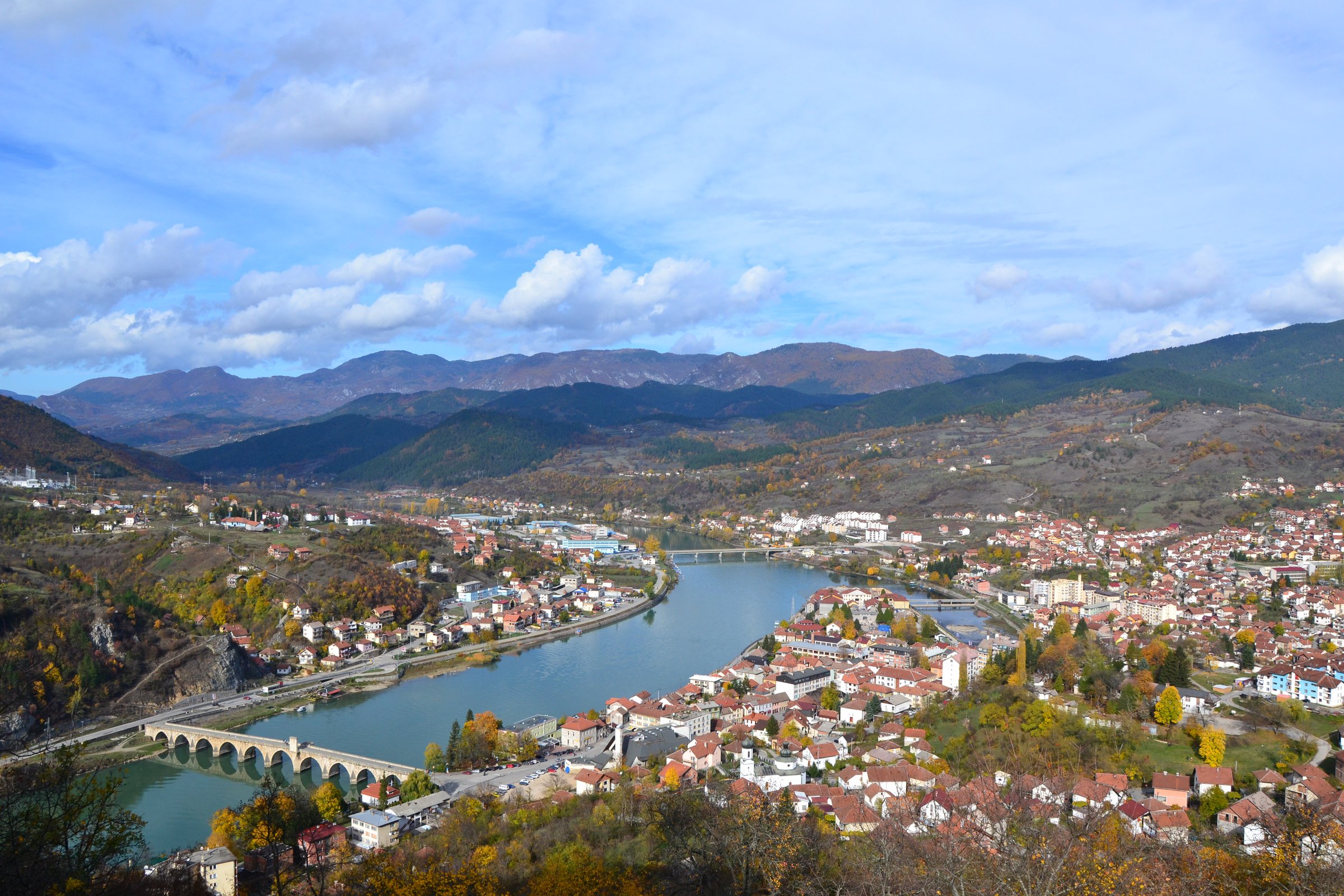
The Mehmed Pasa Sokolovic bridge is eleven arches and about 180 meters of pale limestone across the Drina. It was commissioned in 1571 by Sokollu Mehmed Pasha, the Grand Vizier of the Ottoman Empire, who was born in a village near Visegrad and taken to Istanbul as a child under the devsirme system. It was designed by Mimar Sinan, the greatest Ottoman architect, the man who built the Suleymaniye mosque. It was completed in 1577 and it has been standing, with repairs, ever since.
UNESCO inscribed it in 2007. What makes it exceptional is not size but proportion: the arches widen toward the center, the piers are shaped to split the current, and the whole thing has an apparently effortless quality that took a very great deal of effort.
What to Actually Do There
Walk it slowly, twice, once in each direction. Ten minutes each way if you are paying attention.
Sit in the kapija, the raised stone terrace at the midpoint with benches built into both sides. This is the heart of the book and the heart of the town, the place where for centuries people met, argued, drank coffee and watched the river. It is still exactly that. Buy a coffee from the cafe on the bank and take it out there.
Go down to the riverbank on the town side and look up. The bridge from water level, with the arches repeating away from you and the Drina running that improbable green underneath, is the photograph.
Come back at night. It is lit, the town is quiet, and it is genuinely beautiful.
Read the Book First, or Do Not
Ivo Andric’s novel about this bridge won the Nobel Prize in 1961. It is a chronicle of four hundred years of Bosnian history told through the people who lived around this one crossing, and it is not a gentle read: the opening chapters include a scene of execution that people remember for the rest of their lives.
You do not need to have read it to appreciate Visegrad. But if you read it before you go, standing in the kapija is a different experience entirely, and the whole town becomes legible. We would suggest it.
Andricgrad: The Complicated Bit
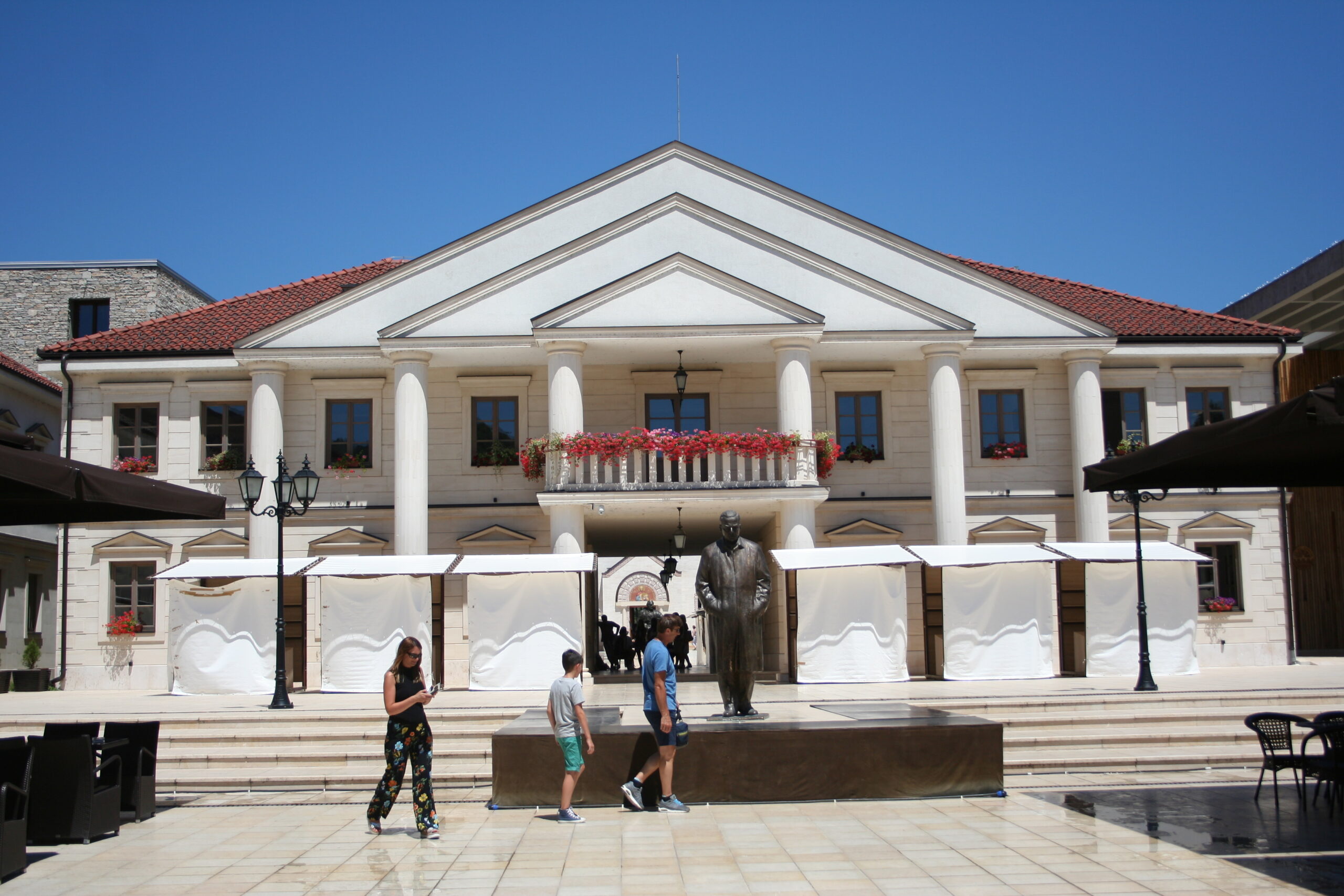
Next to the bridge is Andricgrad, also called Kamengrad, a walled stone town of about 50 buildings built between 2011 and 2014. It contains a church, a cinema, a theatre, shops, restaurants, apartments and a square with a statue of Andric.
It looks four hundred years old. It is not. It was conceived and built by the film director Emir Kusturica as a homage to Andric, as a film set, and as a working town.
It is worth walking through, it takes about half an hour, and the restaurants and cafes in it are decent. It is also worth knowing that it is contested. Critics have argued it presents a selective version of the region’s history and that its construction, in a town with the history Visegrad has, is a political statement as much as a cultural one. Supporters see it as a serious attempt to build something beautiful and permanent in a place that badly needed investment.
We are not going to resolve that for you. We think you should go, look at it, know what it is, and form your own view.
Visegrad’s Recent History
We have to say this plainly, because it matters and because a guide that leaves it out is not being straight with you.
Visegrad was the site of severe atrocities against its Bosniak population in 1992, including killings on and around the bridge. The town’s population was fundamentally changed. The International Criminal Tribunal for the former Yugoslavia convicted several people of crimes committed here. A memorial to the victims exists in the town, though its presence has been contested locally.
None of this makes Visegrad a place you should avoid, and nobody there will be anything other than welcoming to you. It does mean it is not a place to visit as a pretty bridge and nothing else. We wrote more about travelling thoughtfully in this country in our guide to whether Bosnia and Herzegovina is safe, which is as much about context as it is about crime statistics.
Beyond the Bridge
Visegrad is a comfortable base for two nights, and there is more around it than the town suggests.
The Sargan Eight railway. A narrow gauge heritage railway that loops through tunnels and over viaducts in a figure eight to climb the mountain, running from Mokra Gora in Serbia to Sargan Vitasi. The Visegrad end connects by a restored section, and a return trip takes a couple of hours. It is a genuinely fun ride and extremely popular with Serbian families. Check schedules ahead, they are seasonal, and note that the full route crosses into Serbia, so bring your passport.
Rafting the Drina. The Drina below Visegrad is calm and green and a very pleasant half day float rather than a whitewater adrenaline trip. Operators run from town in summer. If you want actual rapids, the Tara near Foca is the place.
Dobrun Monastery. A Serbian Orthodox monastery about ten kilometers east toward the border, founded in 1343, with surviving medieval frescoes. Quiet, free, and about an hour of your time.
Vardiste and the border villages. If you have a car and an afternoon, the road east toward Serbia runs through a string of small villages and there is good, unspectacular, entirely unvisited countryside.
Perucac lake and the Vrelo river. Downstream, on the Serbian side, the Vrelo is often described as the shortest river in Europe at 365 meters. It is a nice hour if you are crossing anyway.
Getting There
By car is the straightforward answer. From Sarajevo the E761 runs east through Rogatica and takes about two and a half hours on decent road with some winding sections. From Belgrade it is around three and a half hours. Parking in Visegrad is easy and free.
By bus, there are daily services from Sarajevo (about three hours) and from Belgrade and Uzice in Serbia. The Sarajevo bus is reliable and cheap. Once in Visegrad you can walk to everything in town, but the Sargan railway and Dobrun need a car or a taxi.
Border note: if you are coming from or continuing into Serbia, this is an international crossing. Carry passports, and if you are driving a rental, confirm with the rental company that Serbia is permitted and that you have the green card insurance document. This trips people up regularly.
For how Visegrad fits into a wider loop, our Bosnia and Herzegovina road trip itinerary covers the routing, though we will be honest that the east is an add on rather than part of the core circuit.
When to Go
May, June and September are ideal. Warm, green, the Drina at its best color, the Sargan railway running, and very few visitors.
July and August are hot in the river valley and bring domestic tourists from Serbia, which is the busiest Visegrad gets and is still not busy. Rafting season is at its peak.
October is lovely, with the hills turning, but some seasonal operations wind down.
November through March is cold and quiet. The bridge in winter mist is atmospheric and the town is very still, but there is not much else running. See our best time to visit Bosnia and Herzegovina for the wider picture.
What It Costs
Visegrad is inexpensive even by Bosnian standards, because it has almost no tourist economy to inflate prices. A guesthouse double runs 50 to 90 KM. A full dinner with drinks is 20 to 30 KM for two people. The bridge is free. Andricgrad entry is free, you pay only in the shops and restaurants. The Sargan railway is around 20 to 25 KM.
Two nights here, including accommodation, food and a railway trip, will cost less than one night in Dubrovnik. Our Bosnia and Herzegovina cost guide has the full comparison.
Where to Book
- Accommodation: Search Visegrad stays on Booking.com. Choice is limited but decent: a few small hotels, several guesthouses, and apartments in Andricgrad itself if you want the novelty. Ask for a room facing the river.
- Tours and activities: Browse Bosnia and Herzegovina tours on Viator. Visegrad specific listings are thin, so for the Sargan railway and Drina rafting, booking locally through your guesthouse is usually easier and cheaper.
- Car rental: Sarajevo is the practical pickup point. Get the Serbia permission and green card sorted at the desk if there is any chance you will cross.
Should You Go?
If you have five days in Bosnia, no. Do Sarajevo, Mostar and the Herzegovina day trips, and save the east for a second visit.
If you have ten days, or you are driving between Sarajevo and Belgrade, or you have read the novel, or you simply want to spend two days somewhere in Europe where you will not hear another language from outside the region: yes, absolutely. Visegrad is the most underrated thing we found in Bosnia and Herzegovina, and the bridge at night with nobody else on it is a memory we have kept.
More Bosnia and Herzegovina reading: our Sarajevo travel guide covers the city you will most likely arrive through, Jajce is the other small Bosnian town that punches far above its size, and how to plan a trip to Bosnia and Herzegovina has the visa, money and driving practicalities in one place.