Disclosure: This post contains affiliate links. If you book through our links, we may earn a small commission at no extra cost to you. Thanks for supporting Faceted Travel!
Table of Contents
- Why Rhodes Is Not a Cyclades Island
- Rhodes Old Town: What to Actually Do
- Lindos, and How to Do It Without Hating It
- The Beaches Worth the Drive
- The Interior Nobody Drives To
- Where to Stay in Rhodes
- Getting There and Getting Around
- Where to Book
- What Rhodes Costs
- When to Go
- What We Would Do Differently
We walked through the Gate of Amboise on our first morning in Rhodes and stopped dead in the middle of a cobbled street, because a medieval city is not what you expect to find on a Greek island. Not a ruin of one. An actual walled town where people live, hang laundry, and argue about parking, inside fortifications built by knights in the fourteenth century.
That is the thing about Rhodes that nobody prepares you for. Most Greek islands sell you white cubes and blue domes. Rhodes sells you a UNESCO-listed crusader city, and then, twenty minutes down the coast, gives you the beaches too. It is the single best island in Greece for travelers who get restless lying on a lounger, and after working through the Cyclades in our Santorini travel guide and Naxos travel guide, it felt like a completely different country.
Here is everything we wish we had known before we booked.
Why Rhodes Is Not a Cyclades Island
Rhodes sits in the Dodecanese, in the far southeast Aegean, close enough to Turkey that you can see the Turkish coast from the beaches on a clear day. It was ruled by the Knights of St John, then the Ottomans, then Italy, and only became part of Greece in 1947. All of that history is still standing.
The practical result is that Rhodes has three separate personalities. There is the Old Town, which is a proper medieval walled city. There is the modern island, with resorts, a real airport, and highways that let you cross from one end to the other. And there is the interior, which is mountains, wine villages, and almost nobody.
It is also big. Rhodes is roughly 50 miles long, which means you cannot see it from a single base without driving. Plan on four to seven days, not two.
Rhodes Old Town: What to Actually Do
The Old Town is the reason to come, and it rewards you for staying in it rather than day-tripping through it.
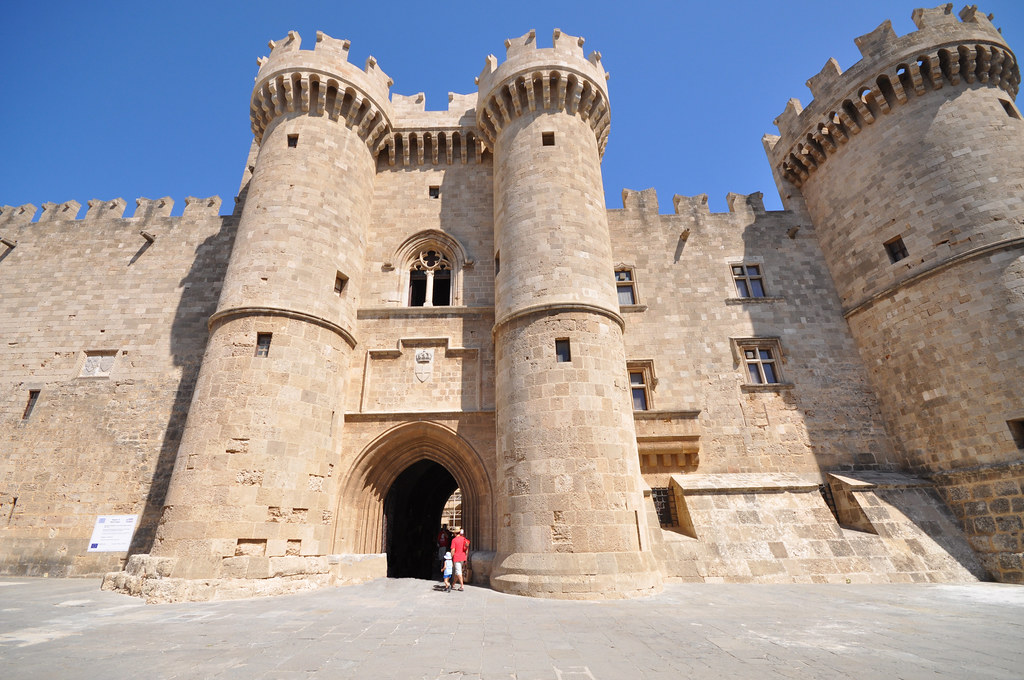
Palace of the Grand Master. The most impressive building on the island, heavily restored under Italian rule in the 1930s and now a museum with extraordinary Roman and early Christian mosaic floors brought over from Kos. Go first thing in the morning before the cruise groups arrive.
Street of the Knights. A steep cobbled lane lined with the medieval inns of the different national orders of the Knights Hospitaller. It is the most intact street of its kind anywhere, and it is free to walk. Do it early or after dark when it empties out completely.
Walk the walls and the moat. The dry moat encircling the Old Town is now a green park you can walk almost the whole way around. It is quiet, shaded, and gives you the scale of the fortifications in a way the streets never do. This was our favorite hour in Rhodes Town and it cost nothing.
Archaeological Museum. Housed in the Knights’ hospital, with the small marble Aphrodite of Rhodes as its centerpiece. Worth an hour even if museums are not usually your thing, mostly for the building.
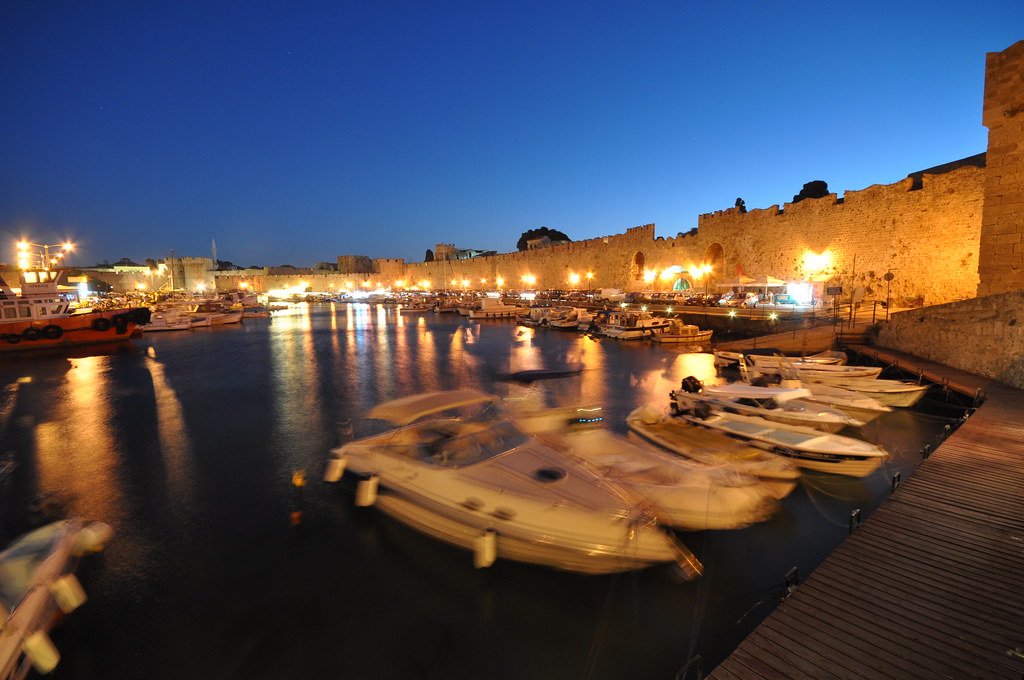
Mandraki Harbour. Where the Colossus of Rhodes supposedly stood, though no one actually knows. Today two bronze deer mark the harbor entrance and three old windmills line the mole. It is a pleasant evening walk rather than a must-see.
Lindos, and How to Do It Without Hating It
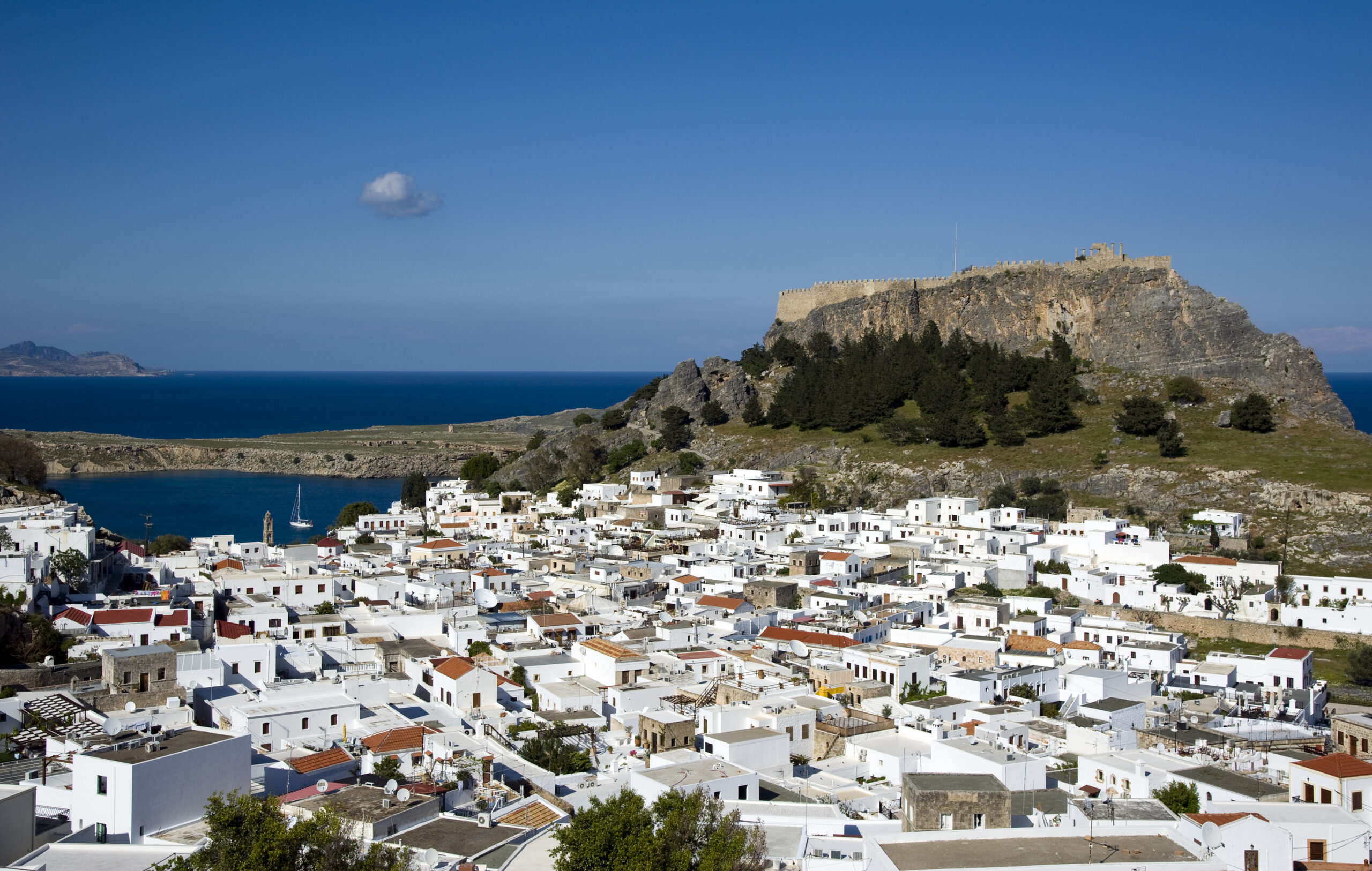
Lindos is the postcard: a white village stacked under an ancient acropolis, with a horseshoe bay below and St Paul’s Bay around the headland. It is also, in July and August, absolutely swarmed.
The fix is timing. Get there before 9am or after 5pm. The acropolis climb is steep and mostly unshaded, and the stone steps get genuinely dangerous in midday heat. We went at opening and had the temple of Athena Lindia almost to ourselves for twenty minutes, which was worth the alarm.
Skip the donkey rides. The animals work in punishing heat on stone stairs, and the welfare situation has been criticized for years. Walk it or come back cooler.
Park in the lot above the village. Cars are not allowed inside Lindos, and the lanes are too narrow for anything wider than a scooter.
The Beaches Worth the Drive
Tsambika. Long, soft sand, shallow turquoise water, and the best all-around family beach on the island. There is a monastery on the headland above it with a serious staircase and a serious view.
Anthony Quinn Bay. A small rocky cove near Faliraki with startlingly clear water, named after the actor who bought land here while filming The Guns of Navarone. Bring water shoes, it is stone not sand, and go early because it is tiny.
Prasonisi. At the southern tip, a sandbar joins the island to a rocky islet, with the Aegean crashing on one side and the calmer Mediterranean on the other. It is the kitesurfing and windsurfing capital of Greece and one of the strangest, most memorable places we have stood in Europe. It is a long drive, about 90 minutes from Rhodes Town, so give it a full day.
Agathi and Stegna. Quiet sandy coves on the east coast near Haraki, far less developed than the Faliraki strip.
The west coast is windier and pebblier because of the meltemi. If you want calm swimming, stay east.
The Interior Nobody Drives To
Renting a car and going inland was the best decision we made on Rhodes.
Embona sits on the slopes of Mount Attavyros, the island’s highest peak, and is the center of Rhodian wine. The Emery winery does tastings, and the village tavernas grill meat over charcoal for a fraction of coastal prices.
Monolithos Castle is a small ruined fortress on a rock spike above the west coast, with a chapel inside and a view that runs for miles. There is no ticket booth and usually no one there.
Valley of the Butterflies (Petaloudes) is a shaded gorge where Jersey tiger moths cluster on the tree trunks in summer. Go in July or August or there is nothing to see, and do not clap at them, which people do and which exhausts the moths.
Ancient Kamiros is a Doric city excavated on a hillside above the sea, with almost none of the crowds of a mainland site. It is the best archaeology on the island after the Old Town.
Where to Stay in Rhodes
Rhodes Old Town is our pick for a first visit. Small boutique hotels in restored medieval houses, everything walkable, and the town transforms once the day trippers leave. The tradeoffs are noise from the bar streets and the fact that you cannot drive to your door, so you will haul luggage over cobbles.
Rhodes New Town / Mandraki is easier logistically, close to the Old Town, with more standard hotels and parking.
Lindos is beautiful to wake up in, but it is car-free, built on a hill, and expensive.
Faliraki is the resort and nightlife strip. Good if that is what you want, avoidable if not.
Kiotari, Lardos, and the southeast are where you go for quiet beach resorts with space, at lower prices than the north.
Getting There and Getting Around
Rhodes has a real international airport (RHO), with direct seasonal flights from across Europe and frequent connections from Athens. Flying is almost always the right call.
Ferries from Piraeus take somewhere between 12 and 17 hours depending on the route and the stops, which is a long night at sea. The ferries that do make sense are the short Dodecanese hops: Symi is about an hour, and Kos, Halki, and Tilos are all easy day trips or onward legs. Booking flights well ahead makes a real difference here, and our guide to the best time to book flights covers the windows that actually save money.
On the island, rent a car. Buses run reasonable east and west coast routes from Rhodes Town, but they will not get you to Monolithos, Embona, or the good empty beaches. Roads are wide and well surfaced by Greek island standards.
Where to Book
We book Greece the same way every time, and Rhodes was no exception.
- Hotels and apartments: Search Rhodes stays on Booking.com. The Old Town boutique properties book out months ahead for June through September, and free cancellation is worth having because ferry plans in the Dodecanese shift with the wind.
- Tours and activities: Browse Rhodes tours on Viator. Symi boat days, Lindos with acropolis entry, Old Town walking tours with a guide who can explain the Knights, and south island 4×4 trips are all easy to book and solve the logistics if you would rather not drive.
For the bigger picture, our complete guide to planning a trip to Greece covers island sequencing, ferry booking, and how many days each region actually needs.
What Rhodes Costs
Rhodes is meaningfully cheaper than Santorini or Mykonos and roughly in line with Crete.
- Mid-range hotel: 90 to 160 euros a night in shoulder season, 140 to 250 in August
- Taverna dinner for two with wine: 35 to 55 euros
- Rental car: 35 to 60 euros a day, less if you book early
- Palace of the Grand Master: around 10 euros
- Lindos Acropolis: around 12 euros
- Symi day trip by boat: 30 to 45 euros
Two people can do Rhodes comfortably on roughly 180 to 250 euros a day in shoulder season including the car, which is good value for what you get.
When to Go
May, June, September, and early October are the sweet spot. Warm sea, manageable crowds, and temperatures you can actually sightsee in.
July and August are hot, busy, and expensive. Rhodes is one of the sunniest places in Greece, which sounds appealing until you are climbing the Lindos acropolis at noon in 95 degrees.
April and late October still work for the Old Town and the interior, with cooler swimming and much lower prices. Some coastal resorts shut entirely.
November through March is very quiet. The Old Town stays alive because people live there year-round, which makes Rhodes one of the few Greek islands that is not a ghost town in winter, but most beach infrastructure closes.
Our guide to the best time to visit Greece breaks the seasons down region by region if you are still deciding.
What We Would Do Differently
We gave Rhodes four days and needed six. Two of ours evaporated on the drive south and back, and we never made it to Symi, which everyone told us afterward was the best day of their trip.
We also based entirely in the Old Town. If we went again we would split it: three nights in the Old Town for the history, then three nights somewhere quiet on the southeast coast for the beaches, and we would not drive back and forth between them every day.
And we would have booked the car before arriving. We paid a walk-up rate in June that was nearly double what we would have paid reserving from home.
Keep planning your Greece trip: Start with our complete guide to planning a trip to Greece for budgets and ferry logistics, then read our Crete travel guide for the other big island worth a week, and our Athens travel guide for the mainland gateway you will almost certainly pass through.