Disclosure: This post contains affiliate links. If you book through our links, we may earn a small commission at no extra cost to you. Thanks for supporting Faceted Travel!
Table of Contents
We went to Naxos because a woman on a ferry told us we were making a mistake by skipping it, and she was right. It is the largest island in the Cyclades, it grows its own food, and it has better beaches than Santorini and Mykonos combined at roughly half the price.
That last part is the whole pitch. Naxos sits an hour by fast ferry from Mykonos and shares the same sea, the same light, and the same whitewashed villages, but it never got fully absorbed into the cruise and influencer economy. People here farm potatoes and make cheese, and the tourism is layered on top of a real place rather than replacing it. If you loved the look of our Santorini travel guide but flinched at the prices, this is the island you actually want.
Here is everything we wish we had known before we went.
Why Naxos Over Santorini or Mykonos
We are not going to tell you to skip Santorini. The caldera is genuinely one of the great views on earth and you should see it once. But the honest comparison looks like this.
Santorini has the view and almost no good beaches. Mykonos has nightlife and beach clubs and a stunning old town, and it is the most expensive island in Greece. Naxos has a proper sandy coastline running for miles, mountain villages at 2,000 feet, marble quarries, hiking, and a Venetian castle you can walk through, and it costs what Greece used to cost.
The other thing that sold us was that Naxos is self-sufficient. It has water, farmland, and livestock, which almost no other Cycladic island does. That means the tomatoes and cheese on your plate came from up the hill, not from a supply boat, and the difference is not subtle.
What Naxos does not have: dramatic sunset caldera views, a big party scene, or direct international flights. If those are the trip, go elsewhere.
When to Go
Naxos follows the Cyclades pattern but stays a bit more livable in high summer because it is big enough to spread people out.
May and June are our pick. Warm days in the 70s and low 80s, the sea starting to warm by mid June, everything open, and prices well below July. The island is green in May, which surprises people who only know the Cyclades as brown rock.
July and August bring heat, full hotels, and the meltemi wind. That wind is why Naxos is a world-class windsurfing and kitesurfing destination, so it is a feature if you are into that and a nuisance if you wanted a still beach day. Book months ahead for August.
September may be the true sweet spot. The sea is at its warmest all year, the crowds thin after the first week, and the light gets softer.
October is lovely and quiet, though ferries reduce frequency and some beach tavernas start closing mid-month.
November through March is very quiet. Naxos Town stays open because people live there, but this is not a beach trip.
Our guide to the best time to visit Greece has the month-by-month detail for the whole country.
Getting There and Getting Around
Naxos has a small airport (JNX) with short flights from Athens on small propeller planes. Seats are limited and sell out early, but the flight is 45 minutes and the approach over the water is beautiful.
Most people arrive by ferry. From Piraeus in Athens, fast ferries take about three and a half hours and conventional ferries about five. From Mykonos it is 30 to 45 minutes, from Santorini about two hours, and from Paros around 30 minutes. The Naxos to Paros to Mykonos to Santorini chain is the classic Cyclades loop and Naxos sits right in the middle of it, which makes it the most logical base of the four.
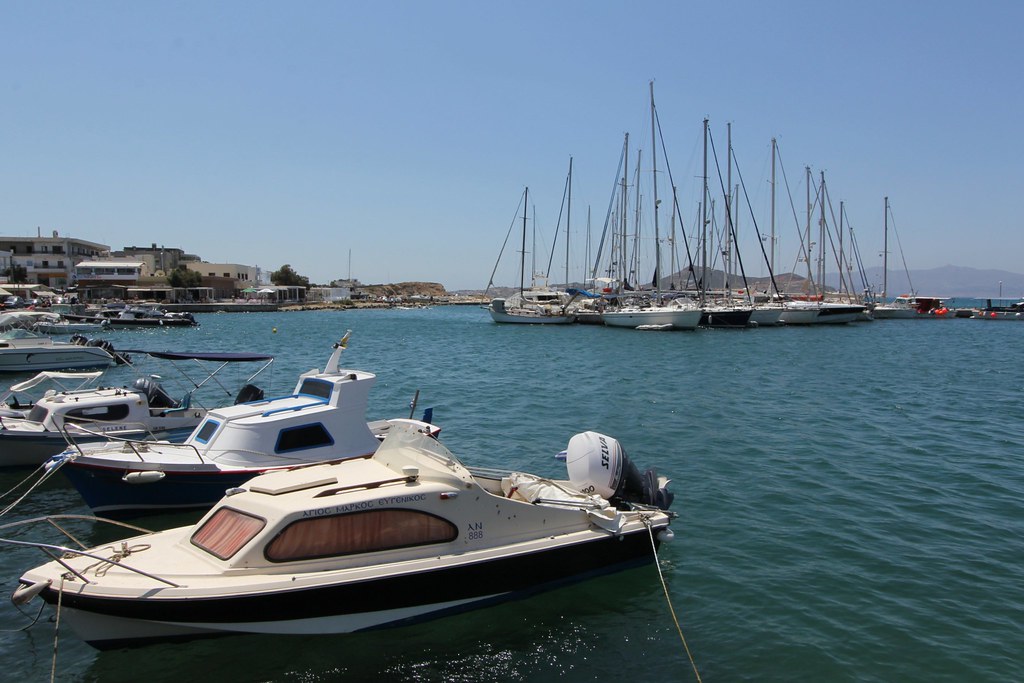
One ferry warning we learned the hard way: high-speed catamarans get cancelled in strong meltemi wind while the big conventional ferries usually still run. If your flight home depends on a boat, take the slow one or build a buffer day.
A car for two or three days is the right call. Naxos Town, the beaches immediately south of it, and the port are all walkable or a cheap bus ride away, and the bus network to the main beaches is decent. But the mountain villages, the marble quarries, and the good hiking need wheels. We rented for three days of a week and that was exactly right.
ATVs and scooters are everywhere and popular. We would rent a small car instead, because mountain roads plus gravel plus wind is not a combination we enjoy on two wheels.
Where to Base Yourself
Naxos Town (Chora) is where most people should stay. It has the Portara, the castle quarter, the ferry port, the widest restaurant selection, and Agios Georgios beach within walking distance. You can live here without a car most days.
Agios Prokopios and Agia Anna are five to ten minutes south, right on the best of the near beaches, with a low-key resort feel and easy bus access to town. This is our pick for a beach-first trip with kids.
Plaka is the long, wide, partly nudist beach a bit further south, more spread out, with a mix of small hotels and rentals. Quieter, still easy.
Apollonas on the far north coast is remote and beautiful and a real commitment, about an hour and fifteen minutes of mountain driving from town.
Halki or Filoti in the interior puts you in the mountains among olive groves and stone villages, which is a completely different and very good trip if the beach is secondary.
Best Things to Do in Naxos
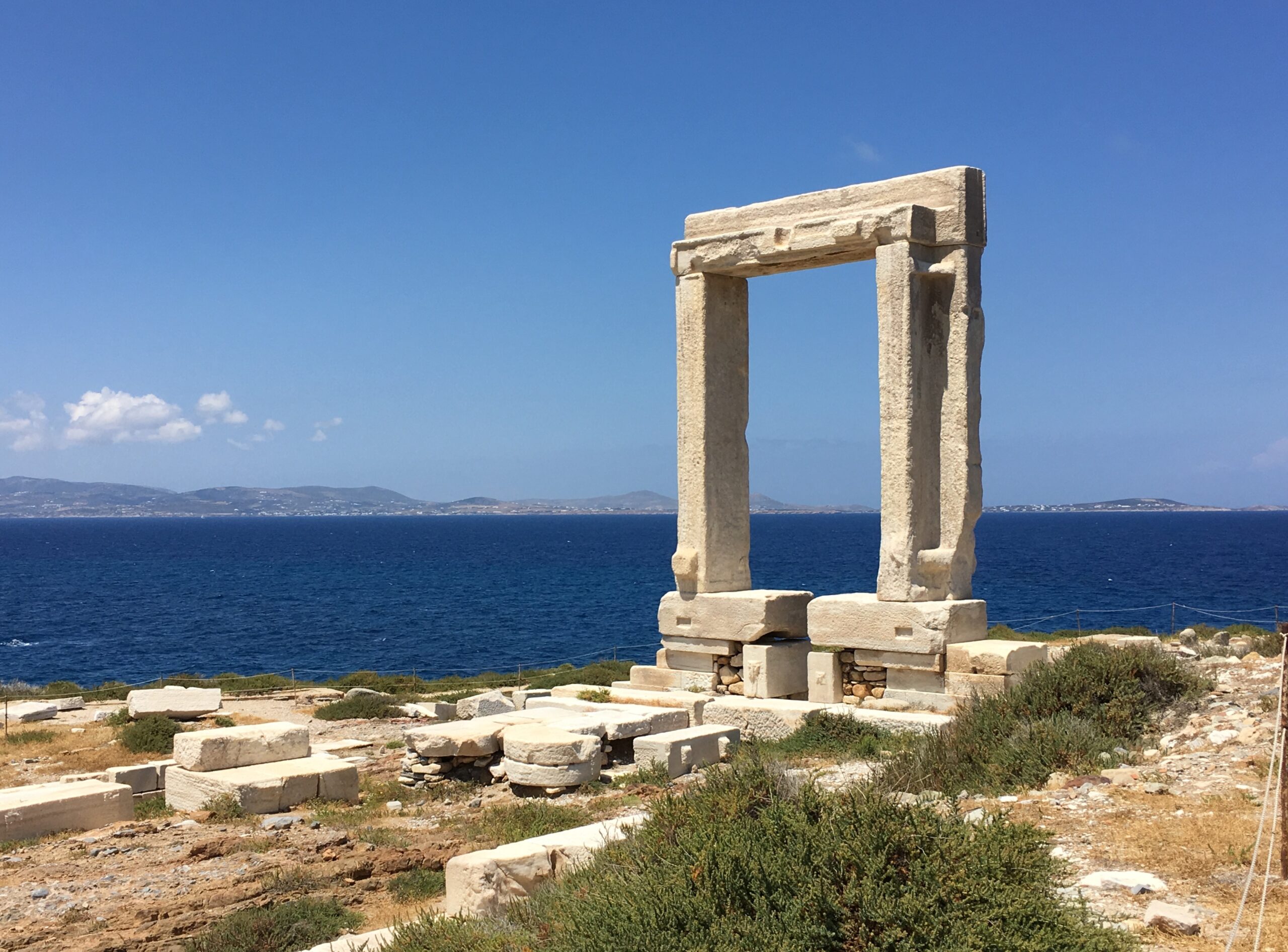
Walk out to the Portara at sunset. A single enormous marble doorframe from an unfinished temple to Apollo, standing alone on an islet connected to town by a causeway. It is the island’s signature image and it is a five minute walk from the port. Go for sunset, then go back another morning when nobody is there.
Get lost in the Kastro. The Venetian castle quarter above Naxos Town is a genuine medieval maze of archways, coats of arms carved over doors, and families who have lived there for centuries. There is no efficient route through it, which is the point.
Drive the mountain village loop. Halki for the old distillery and the citron liqueur, Filoti at the foot of Mount Zas, Apiranthos built entirely of marble with marble streets, and Moutsouna down on the east coast. This is a half day and it is the best half day on the island.
Find the kouroi. Two abandoned ancient marble statues, each over 20 feet long, lying in the fields where they cracked during carving 2,500 years ago and were simply left. One near Melanes, one near Apollonas. There is no fence and no ticket booth at one of them, just a giant unfinished god in an olive grove.
Climb Mount Zas. The highest point in the Cyclades at 3,295 feet, where Zeus was supposedly raised. Three hours round trip from Filoti, with a cave on the way and a view over half the archipelago at the top.
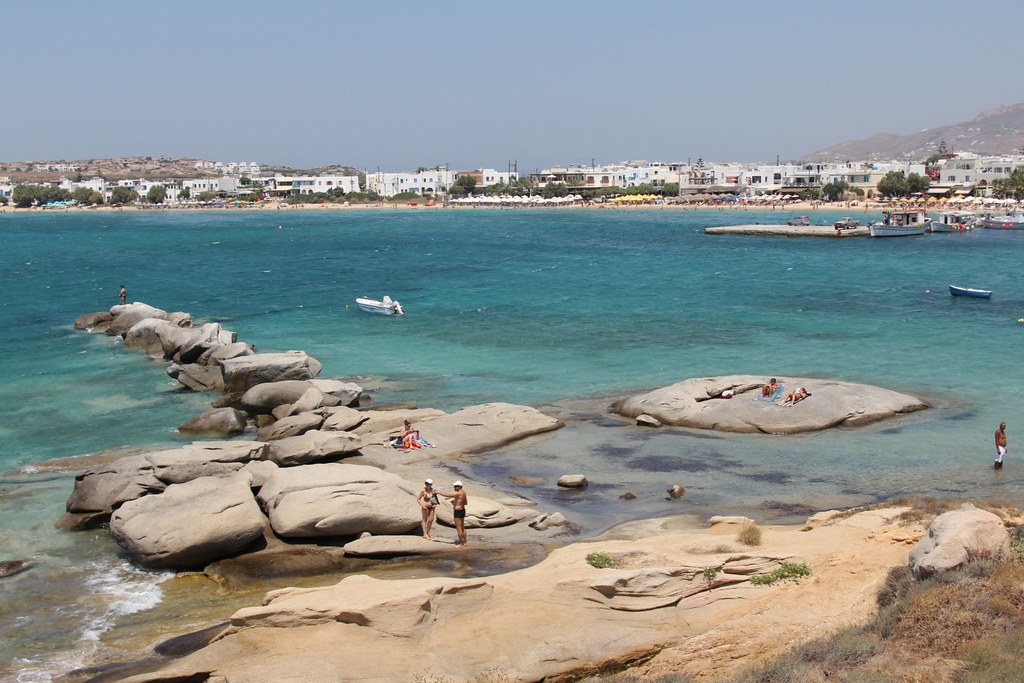
Do a beach day properly. Agios Prokopios, Agia Anna, Plaka, Mikri Vigla for the wind sports, and Alyko with its abandoned hotel and cedar forest. The sand runs almost continuously for eight miles.
What and Where to Eat
Naxos is the only Cycladic island where we would call the food a reason to go rather than a thing you do between activities.
The island produces its own potatoes, which Greeks treat as a genuine specialty and which show up on every menu. It makes graviera, a hard nutty cheese with protected origin status, plus arseniko and the soft xinomizithra. It raises its own lamb and goat. It bottles kitron, a citrus liqueur distilled from the leaves of the citron tree, which is made almost nowhere else on earth.
What we would order: anything with graviera, the local potatoes roasted with lemon and oregano, grilled octopus at a harbor table, and whatever the mountain tavernas have cooked in a pot that day. Ask what is in the pot. That is usually the answer.
Where we would eat: the harbor front in Naxos Town is fine and convenient but priced for the view. Walk two streets back into the old town for better food at lower prices. In the villages, Halki and Apiranthos both have small places with four or five tables where the menu is spoken rather than printed. Down at Moutsouna on the east coast, the seafood comes off boats you can see from the table.
One habit worth adopting: order less than you think, because the free dessert and raki at the end are not small.
How Many Days You Need
Three days covers Naxos Town, the Portara, the Kastro, and two beach days. Enough to understand why people like it.
Five days is our recommended minimum. Add the mountain village loop, a proper hike, and enough unstructured time to eat a long lunch and not look at a clock.
A week lets you add Mount Zas, the kouroi, the far north at Apollonas, and a day sail out to the Small Cyclades, which are the tiny nearly-empty islands just south of Naxos. This is the length we would book if we went back.
Ten days or more and you can use Naxos as a base for day trips to Paros, Koufonisia, and Delos, returning each evening rather than moving hotels. Because Naxos sits in the middle of the Cyclades ferry web, this hub-and-spoke approach works better here than from any other island.
Where to Book
We book almost everything for the Cyclades through two places, and Naxos was no exception.
- Hotels and apartments: Search Naxos stays on Booking.com. Naxos Town has the most inventory and the beach villages south of it have the best value, and free cancellation is worth having when ferries are weather-dependent.
- Tours and activities: Browse Naxos tours on Viator. Mountain village tours, sailing day trips to the Small Cyclades, cooking classes using island produce, and windsurfing lessons at Mikri Vigla are all easy to book here.
For a longer Greece trip, our complete guide to planning a trip to Greece covers ferry sequencing, budgets, and how many islands you can realistically fit.
What Naxos Costs
This is where Naxos makes its case loudly.
A comfortable mid-range double in Naxos Town ran us around 80 to 120 euros a night in June, against 250 and up for anything comparable with a view in Santorini. A rental car was 40 to 55 euros a day. A full taverna dinner for two with a carafe of local wine was 30 to 45 euros, and we ate very well at the low end of that.
Ferries are the cost people forget. Athens to Naxos on a fast boat runs 55 to 75 euros per person each way, and island hops are 25 to 45 euros. Book those ahead in July and August. Our breakdown of what a trip to Europe costs sets these against the rest of the continent.
A Few Things We Would Do Differently
We gave Naxos four days and wanted seven. It is the rare Greek island where you can genuinely fill a week without repeating yourself, and we spent our last day making a list of what we had missed.
We also rented the car at the start when we were still in beach mode and barely used it for two of the three days. Rent it in the middle of your stay, after you have had a few slow days and are ready to explore.
And we would eat more meals in the mountain villages. Every good meal we had was above 1,500 feet, in a place with four tables and no menu in English.
—
Keep planning your Greece trip: Start with our complete guide to planning a trip to Greece for ferry logistics and budgets, then read our Santorini travel guide and Mykonos travel guide for the two islands most people pair with this one.