Disclosure: This post contains affiliate links. If you book through our links, we may earn a small commission at no extra cost to you. Thanks for supporting Faceted Travel!
Table of Contents
Krka is the Croatian waterfall park people confuse with the other Croatian waterfall park, and then they get there and understand immediately why both exist. Where Plitvice is a long, quiet, terraced staircase of lakes deep in the interior, Krka is a wide river cutting through a limestone canyon an hour from the coast, with a single enormous cascade at the end of a boardwalk and a monastery on an island in the middle of it.
It is also the one you can fold into a beach trip without rearranging your whole itinerary. If you are staying in Split, Zadar, Sibenik, or Trogir, Krka is a comfortable half day. Here is how to do it well, including the entrance question that trips almost everyone up.
What Krka National Park Actually Is
Krka protects roughly 109 square kilometers along the Krka River between Knin and Sibenik. The river runs through a karst canyon and, along the way, deposits calcium carbonate that builds natural travertine barriers. Those barriers are the waterfalls. They are alive and slowly growing, which is why the park is so protective of them.
There are seven main waterfall systems. Two matter for most visitors:
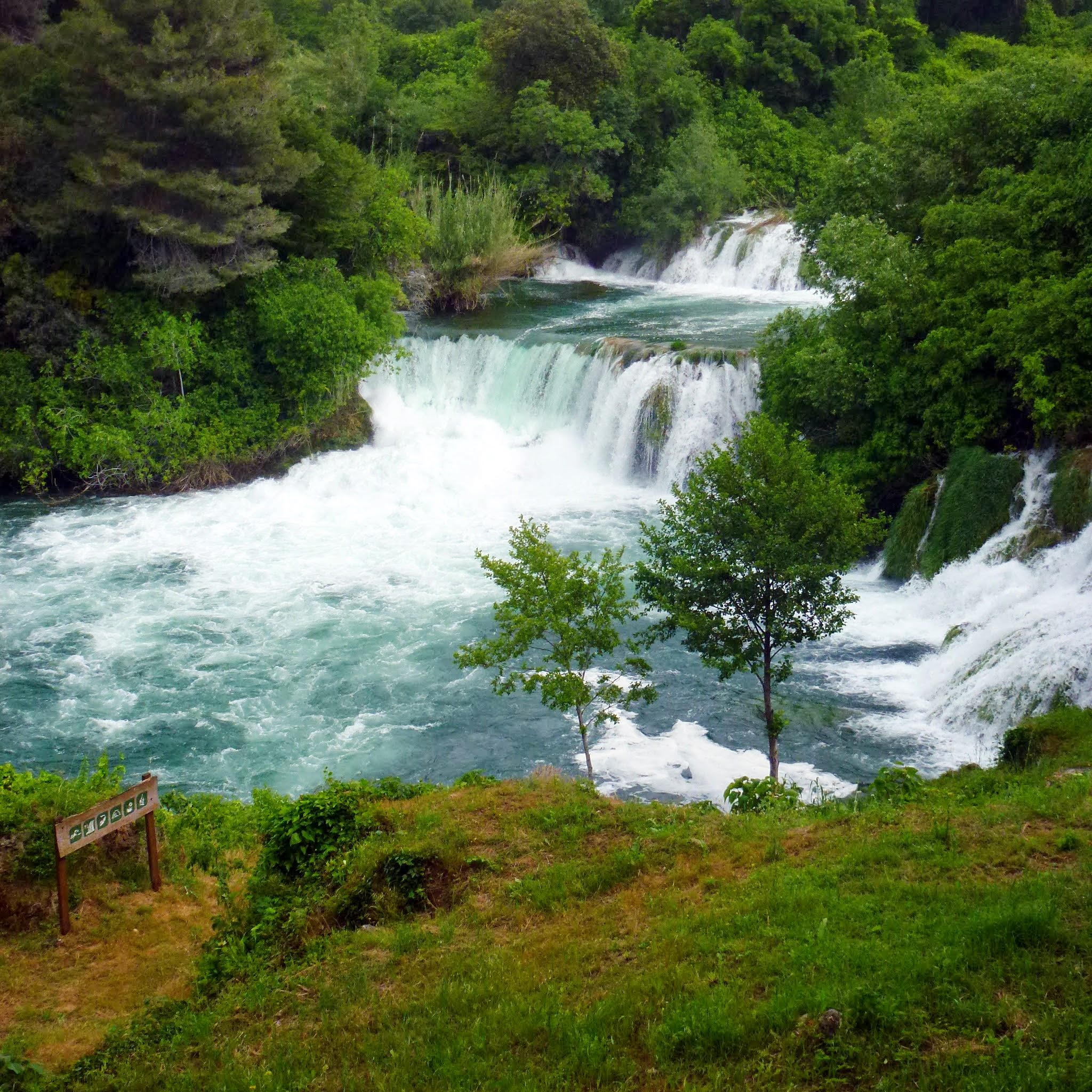
- Skradinski Buk, the big one at the southern end, a 400 meter long cascade system dropping about 45 meters across seventeen steps. This is the photo you have seen.
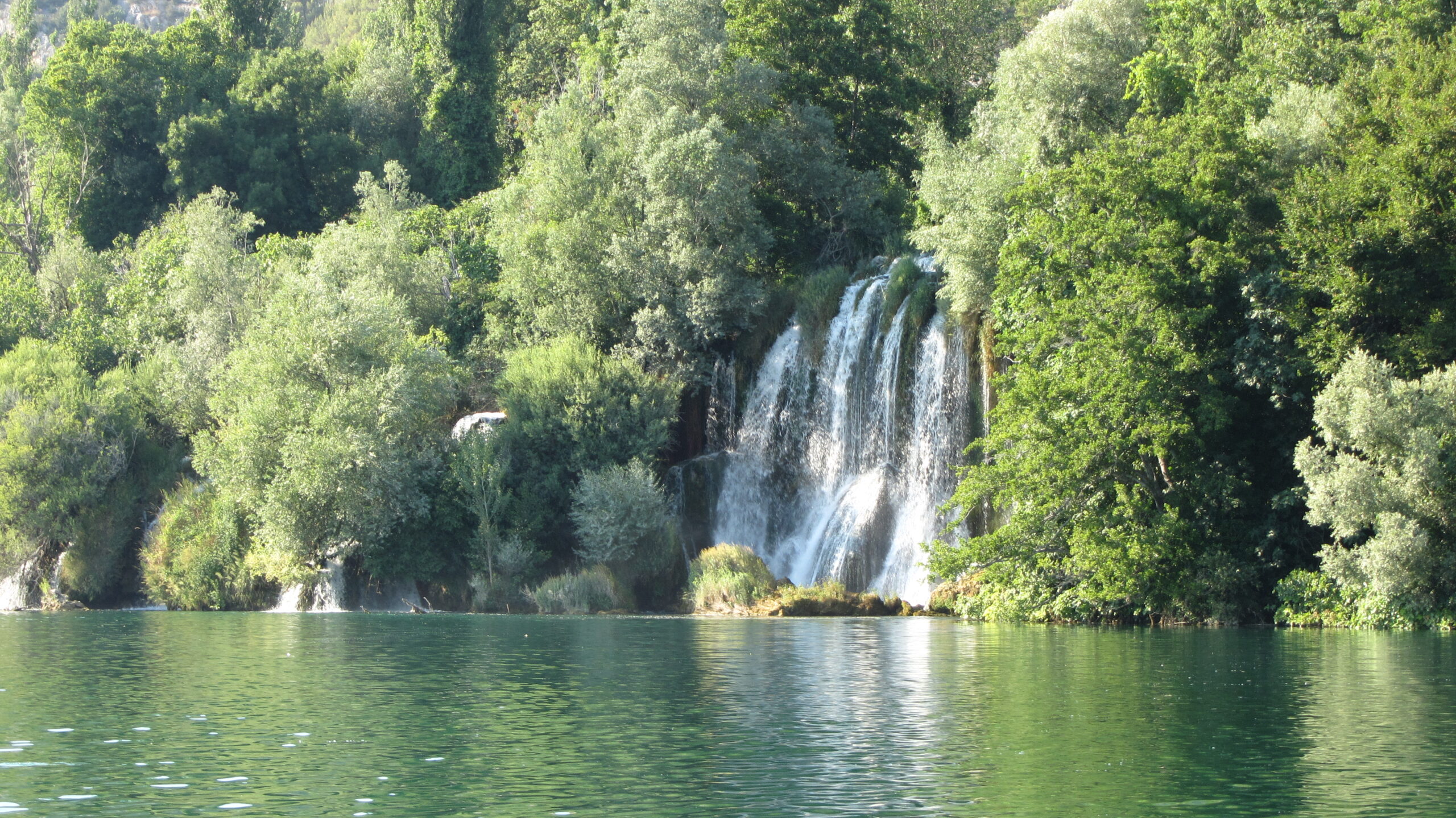
- Roški Slap, further upriver, wider and gentler, with a section locals call “the necklaces” and a set of restored watermills.
Between them sits Visovac, a small island holding a Franciscan monastery founded in the 15th century, reachable only by boat and genuinely one of the loveliest things on the Croatian mainland.
The Entrance Question (Read This First)
Krka has five entrances and choosing wrong costs you an hour.
Skradin is the classic approach. You park in the town of Skradin, buy your ticket, and take the park’s included boat 25 minutes up the river to Skradinski Buk. The boat ride is a genuine highlight and the approach from the water is beautiful. The catch: boats run on a schedule, capacity is limited, and in July and August the queue can be long.
Lozovac is the practical approach. You park above the falls and either walk down a switchback path (about 20 minutes) or take the park shuttle bus. You arrive at the top of Skradinski Buk and work down. It is faster and more reliable in peak season, and the parking is bigger.
Roški Slap and Burnum/Puljane serve the upper river. Roški Slap is worth a separate visit if you have time, and it is far quieter than Skradinski Buk.
Kistanje/Krka Monastery is the fifth, for the Orthodox monastery upriver.
Our rule: Skradin if you arrive before 9am or after 3pm, Lozovac if you arrive in the middle of the day. In shoulder season, take Skradin every time for the boat.
Can You Swim at Krka?
Not at Skradinski Buk anymore. Swimming at the base of the main falls was banned starting in 2021 to protect the travertine, and the ban has held. This is the single most common outdated piece of advice online, so ignore any blog post or video still showing people bathing under the big cascade.
You can swim in designated spots elsewhere in the park, including a marked area near Roški Slap and stretches of the river accessible from Skradin. If a swim under a waterfall is the non negotiable part of your trip, be aware that the iconic one is off the table and plan accordingly.
Best Time to Visit Krka
Spring (April to early June) is the best overall. Water volume is high after the winter rains, so the falls are thundering, the canyon is green, and crowds are manageable. May is close to perfect.
Autumn (September and October) is the runner up. Fewer people, comfortable walking temperatures, still enough water to be dramatic. October can be very quiet.
Summer (July and August) is the busiest and the hottest, with midday temperatures over 30C/86F and very little shade on the boardwalks. Water flow is at its lowest, so the falls look thinner than the photos. If summer is your only option, go at opening or in the last two hours.
Winter is dramatic and nearly empty, with the highest water volume of the year. Some trails and boat services close, and the Visovac and Roški boat excursions generally do not run.
Time of day matters more than season. The park opens early (8am most of the year, 9am in winter). Arriving at opening buys you the boardwalks nearly to yourself for the first hour, and it is a completely different experience from 1pm.
What to See and Do
Walk the Skradinski Buk Boardwalk
The main loop is about 1.9km of wooden boardwalk and gravel path, mostly flat, taking 60 to 90 minutes at a photography pace. It winds through the travertine terraces, over side channels, past restored watermills, and finishes at the viewpoint over the main drop. It is stroller-difficult but manageable, and fully walkable for most fitness levels.
Visit the Ethno Village Watermills
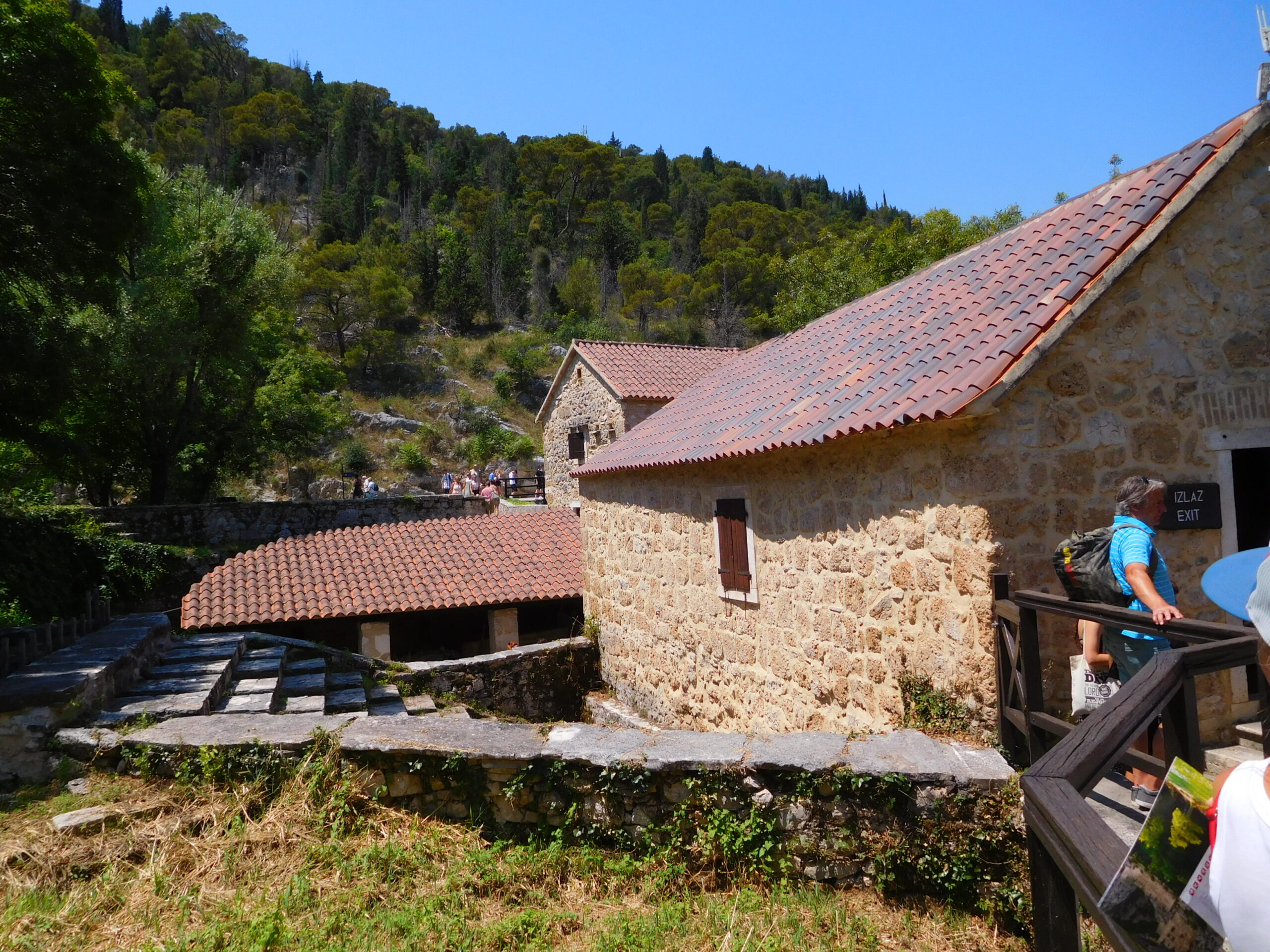
Along the boardwalk you pass a cluster of stone buildings that once ground grain using the river. Several have been restored with working demonstrations, plus displays of traditional Dalmatian tools, textiles, and a small shop selling local honey, figs, and rakija. It takes fifteen minutes and it contextualizes the whole canyon: this was a working landscape long before it was a park.
Take the Boat to Visovac Island
This is a separate paid excursion (roughly 2 hours round trip) departing from the upper boat dock near Skradinski Buk. You cross the widened stretch of river, land on the island, and get a guided walk through the monastery, its church, and a small museum with an illuminated manuscript collection. The approach across the water, with the monastery and cypresses rising out of the middle of the river, is the image that stays with you.
See Roški Slap
Either as a boat excursion from Skradinski Buk or by driving to its own entrance. Roški Slap is wider and lower than the main falls, with a series of small cascades called the necklaces spilling down through the trees, plus more watermills and a much calmer atmosphere. If Skradinski Buk feels like a queue, Roški Slap is the antidote.
Explore Burnum
A Roman military camp with the remains of an amphitheater and an arched command building, plus the nearby Manojlovac waterfall, which is the tallest in the park at 59.6 meters and often overlooked entirely. Worth it for anyone who likes ruins with no rope lines.
Krka vs Plitvice: Which Should You Choose?
We get asked this constantly, so plainly:
Choose Krka if you are based on the coast, you have half a day rather than a full one, you want the boat approach and the monastery, or you are traveling with people who do not want a long walking day.
Choose Plitvice if you want the more spectacular landscape, you have a full day, you are traveling between Zagreb and the coast anyway, or you have seen photos of the turquoise terraced lakes and that is the thing you actually want.
Choose both if you have the time. They are 90 minutes apart and they are genuinely different experiences, not duplicates. Plitvice is the bigger natural event. Krka is the more comfortable, more human one.
Getting to Krka National Park
From Sibenik: 15km, about 25 minutes to Skradin. Closest base by a wide margin.
From Split: 85km, about an hour by car on the A1. Day tours run constantly in season.
From Zadar: 75km, about an hour. Also very easy.
From Zagreb: about 3.5 hours, so it is a long day trip. Combine with Plitvice on a driving route instead.
Without a car: buses run to Skradin and Lozovac from Sibenik and Split in summer, but schedules are thin. Most people without a car book an organized day trip, which usually includes transport, entry, and free time at the falls.
Tickets, Hours, and Practical Details
- Entry is timed and seasonal. Peak summer adult tickets run roughly 40 euros, dropping to around 20 euros in shoulder season and much less in winter. Children and students get reduced rates.
- Book online in advance for July and August. Ticket slots genuinely sell out, and the Skradin boat has its own capacity limit on top of that.
- Boat excursions to Visovac and Roški Slap are extra, usually 15 to 25 euros, and are booked inside the park on the day.
- Bring: water (refill points exist but are limited), sun protection, a hat, and proper shoes. The boardwalks get slick.
- Food: there is a restaurant and a couple of snack points near Skradinski Buk, decent but not cheap. Skradin town has much better eating, and its own local specialty, Skradinski rižot, a beef risotto stirred for hours.
- Dogs are allowed on a leash on most trails, which is unusual for a Croatian national park.
- Allow 3 to 4 hours for Skradinski Buk with the boardwalk and a relaxed pace. Add 2 hours for Visovac, another 2 to 3 for Roški Slap.
Where to Stay Near Krka
Skradin is a small, pretty marina town at the park entrance and our pick for an overnight. Waking up and being on the first boat is a real advantage, and dinner on the waterfront is lovely.
Sibenik is 25 minutes away, a proper Dalmatian city with a UNESCO cathedral, a hilltop fortress with concerts, and far more restaurants and hotels than Skradin.
Split or Zadar work as bases if Krka is one stop among many. Both are an hour out. See our guide to planning a trip to Croatia for how to string these together.
Where to Book
- Hotels and apartments: Booking.com has the best coverage for Skradin and Sibenik, where most inventory is small family run apartments rather than chain hotels. Book early for June through September.
- Day trips and tours: Viator lists Krka day trips from Split, Zadar, Trogir, and Sibenik, most including park entry, and several combining Krka with Sibenik or a wine tasting. This is the easiest option without a car.
- Park tickets: buy directly from the national park’s official site for timed entry, then book any boat excursions on arrival.
Krka is the Croatian park that fits into a real vacation. You can be swimming in the Adriatic at nine, standing in front of a 45 meter travertine cascade at noon, and back on a terrace with grilled fish by seven. Go early, take the boat if you can, and give yourself the extra two hours for Visovac. That island is the part nobody tells you about, and it is the part we still talk about.
More Croatia from Faceted Travel: Pair this with our Plitvice Lakes National Park guide if you are deciding between the two, our Split, Croatia Travel Guide for the most common base, and How Much Does a Trip to Croatia Cost? to build the budget.