Disclosure: This post contains affiliate links. If you book through our links, we may earn a small commission at no extra cost to you. Thanks for supporting Faceted Travel!
Table of Contents
Trogir sits on a tiny island between the Croatian mainland and the island of Ciovo, fifteen minutes from Split airport, and most travelers see it for exactly as long as it takes the airport shuttle to pass the turnoff. That is a mistake we made ourselves the first time. On our second trip through Dalmatia we finally stopped, walked across the little bridge into the old town, and realized we had been rushing past one of the most complete medieval towns on the entire Adriatic coast.
The whole historic center is a UNESCO World Heritage site, and unlike a lot of places carrying that label, Trogir earns it in a way you feel rather than read on a plaque. The streets are so narrow that two people with backpacks have to turn sideways. The stone has that warm honey color that only happens when limestone has been sitting in Mediterranean sun for eight hundred years. And because the island is small enough to walk across in ten minutes, you never get that overwhelmed feeling that a bigger old town can give you.
Here is everything we wish we had known before our first proper visit.
Why Trogir Is Worth More Than a Photo Stop
The short version: Trogir is what Split would feel like if Split were one twentieth the size and had no cruise terminal.
Split is wonderful, and we have written a whole Split travel guide about why we keep going back. But Diocletian’s Palace absorbs a lot of people, and by mid morning in July the main squares are shoulder to shoulder. Trogir gets day trippers too, but they arrive in a predictable wave between about 10am and 4pm, and they concentrate on one main street. Step one block off it and the town belongs to whoever is standing there.
The other reason to stop is the density of things worth looking at. Trogir packs a Romanesque cathedral with a carved portal that art historians travel specifically to see, a Venetian fortress you can climb for sunset, a fifteenth century town loggia, and a waterfront promenade lined with palms, all inside an area you could cross in a few minutes. For a town of roughly 13,000 people, that is a lot.
Getting to Trogir
Trogir is genuinely easy to reach, which is part of why it makes such a good first or last stop on a Croatia trip.
From Split Airport
This is the big one. Split airport is actually in Kastela, about 6 km from Trogir and 25 km from Split city. A taxi to Trogir runs roughly 15 to 20 euros and takes ten to fifteen minutes. There is also a local bus (line 37) that stops on the main road near the airport and continues to Trogir for a couple of euros.
If you are flying into Split and your first night is in Trogir rather than Split, you save yourself the airport transfer entirely on arrival day. We now do this on purpose: land, drop bags in Trogir, and start the trip with a quiet dinner on the waterfront instead of a highway ride.
From Split City
Bus 37 runs between Split’s suburban bus station (not the main harbor station) and Trogir roughly every 20 to 30 minutes, and the ride takes about 50 minutes because it stops constantly through the Kastela villages. It is cheap and it works, but it is slow.
Faster options are the seasonal Bura Line catamaran, which does the Split to Trogir run by sea in about 30 minutes in summer and is far more pleasant, or a taxi or rideshare for around 35 to 45 euros.
By Car
Trogir sits just off the A1 motorway and the coastal D8. If you are doing a Dalmatian road trip, it slots in naturally. The catch is parking: you cannot drive into the old town, and the closest lots fill early in summer. There is a large garage on Ciovo just across the south bridge, and a big surface lot on the mainland side near the market. Expect roughly 2 to 3 euros an hour in season.
Things to Do in Trogir
Cathedral of St Lawrence and the Radovan Portal
Start here. The cathedral took roughly four centuries to finish, which is why walking around it feels like flipping through an architecture textbook, but the reason to come is the west portal carved by a local master named Radovan in 1240. It is considered the finest Romanesque sculpture in Croatia, and standing in front of it you can see why: Adam and Eve on either side, a riot of lions, apostles, hunting scenes, and a calendar of the working year carved in stone.
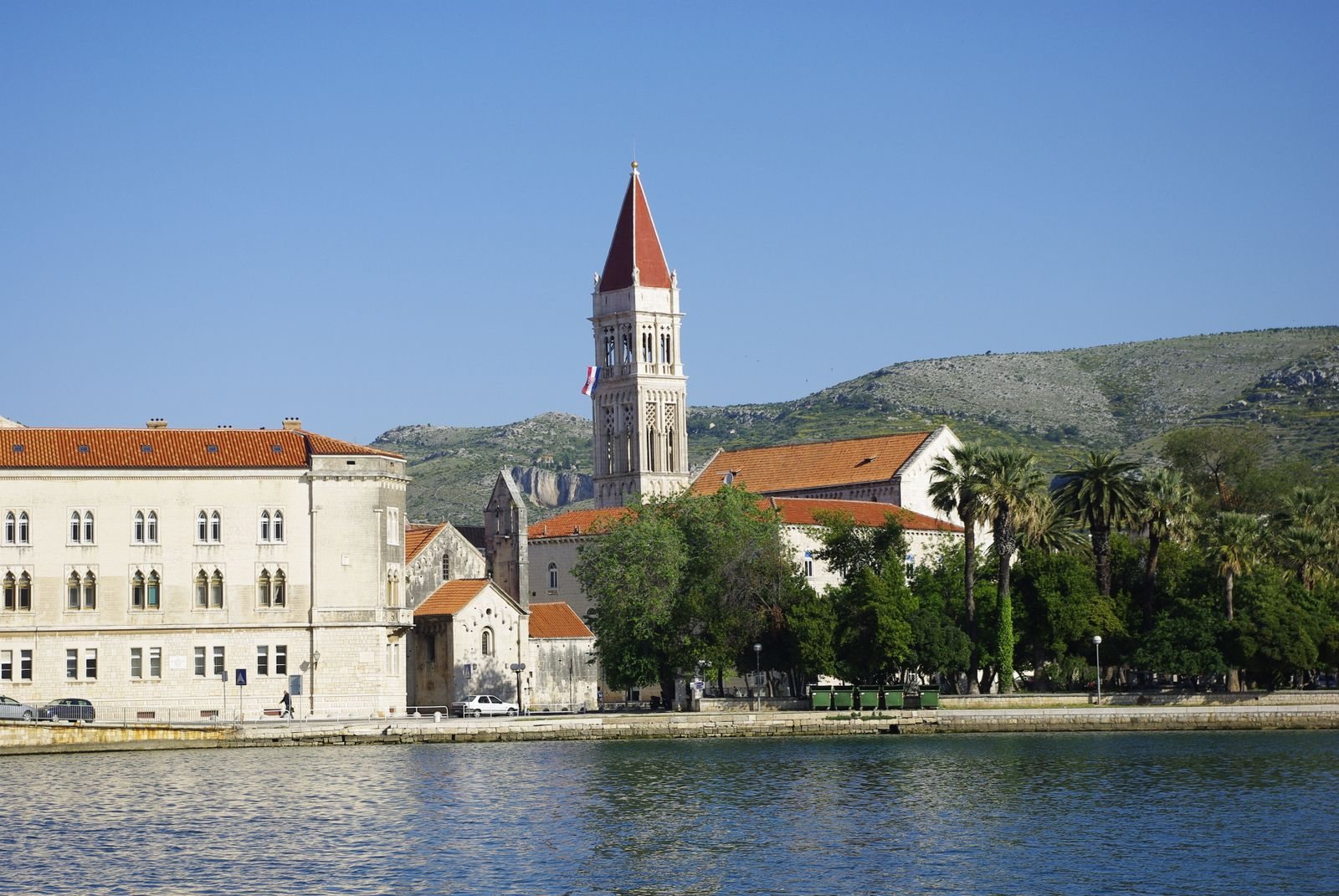
Climb the bell tower if you have the legs for it. The staircase is tight and the railings are minimal, but the view over the terracotta rooftops and out to the channel is the single best photo in town.
Kamerlengo Fortress
The fifteenth century Venetian fortress anchors the southwest corner of the island. From the outside it looks like a sandcastle someone built at enormous scale. Inside it is mostly an empty courtyard, and honestly the entry fee is worth it only for one thing: the walk around the top of the walls at golden hour, looking back at the old town on one side and the channel on the other. In summer the courtyard sometimes hosts concerts and open air film screenings, which is a lovely way to spend an evening.
The Riva and the Waterfront
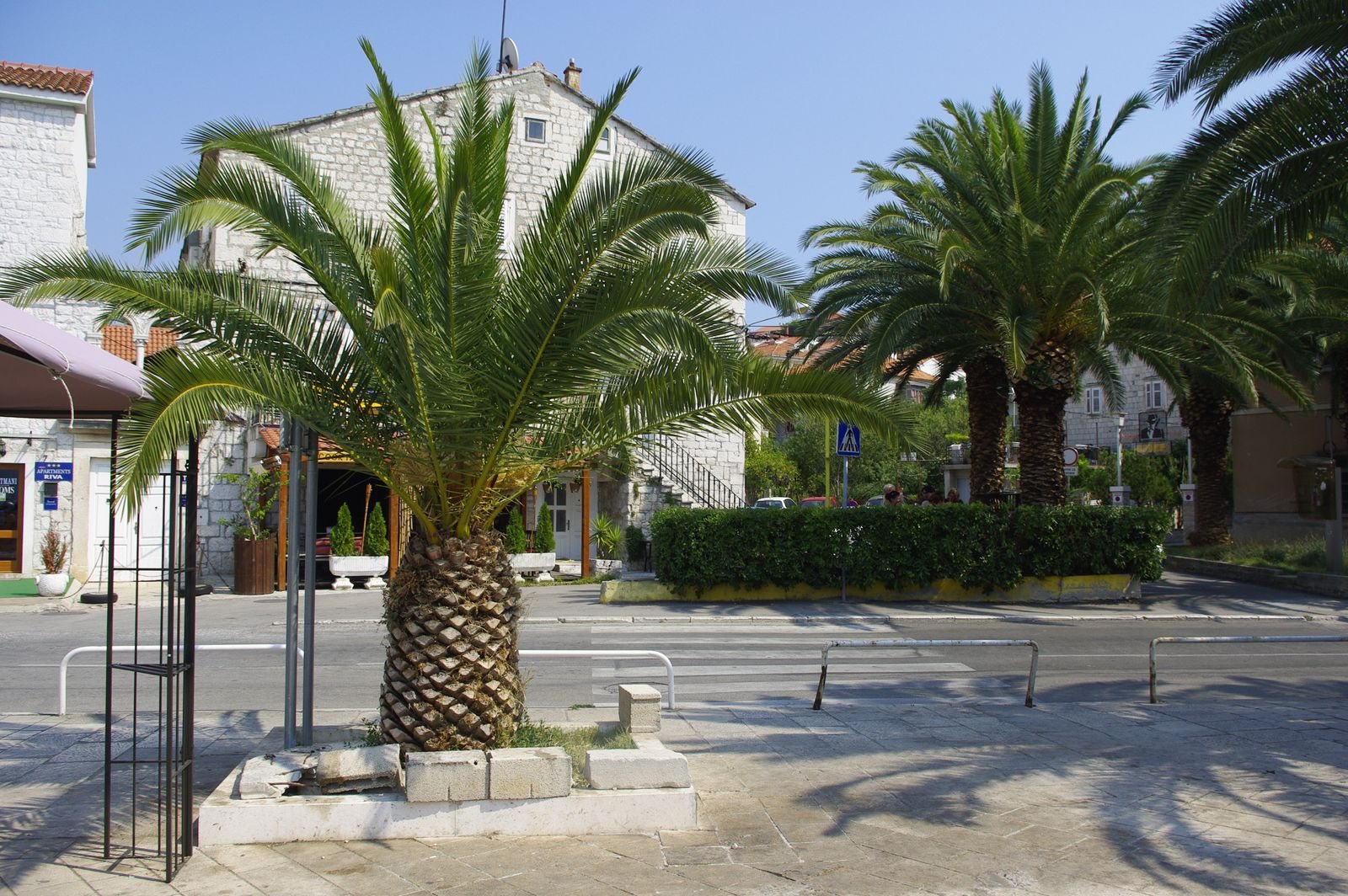
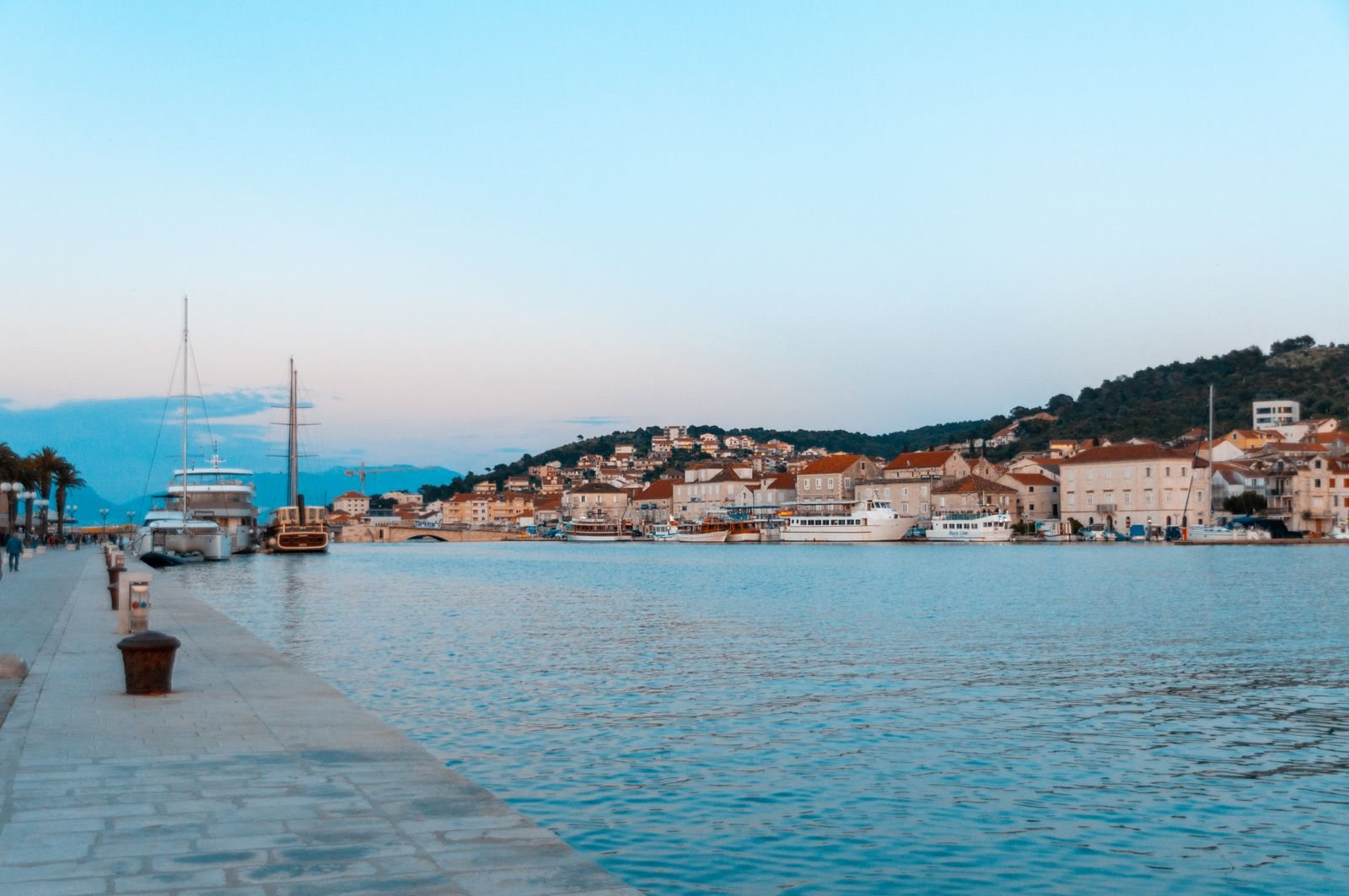
Trogir’s promenade runs the whole southern edge of the island, palm trees on one side, an improbable line of yachts on the other. It is the most pleasant evening walk we have found anywhere in Dalmatia, partly because it is genuinely flat, partly because the light coming off the water at dusk turns all that stone gold.
Do the walk at around 7pm, get a drink at one of the cafes with the tables spilling out onto the stone, and just watch. The local ritual of the evening stroll is alive and well here.
The Town Loggia and Cipiko Palaces
On the main square opposite the cathedral, the fifteenth century loggia is an open pillared hall that served for centuries as the town’s courthouse. There is a relief above the judge’s bench and a rather famous clock. Across the square, the Cipiko palaces belonged to Trogir’s most powerful family and show off the Venetian Gothic windows you see all along this coast.
None of this takes long. That is the point of Trogir. You can see the headline sights in a morning and still have the whole afternoon.
The Green Market and Fish Market
Just over the north bridge on the mainland side, Trogir’s market is small, cheap, and completely unglamorous, which is exactly why we like it. Figs, tomatoes, olive oil in reused bottles, and a covered fish hall where the catch changes daily. If you have an apartment with a kitchen, this is your dinner.
Best Time to Visit Trogir
May, June, September and early October are the sweet spots. Water is warm enough to swim by early June and stays that way into October. July and August bring real heat, real crowds, and real prices, and the narrow stone streets hold heat like an oven.
We have a fuller breakdown in our guide to the best time to visit Croatia, but for Trogir specifically, September is the standout. The day trip buses thin out noticeably after the first week, the sea is at its warmest, and you can get a waterfront table without a reservation.
Winter is very quiet. Many restaurants close, and the town takes on a shuttered, local feeling that some travelers love and others find bleak. Go in winter only if quiet is the entire point.
Where to Stay in Trogir
There are three broad choices, and they suit different trips.
Inside the old town. Apartments and small boutique hotels in restored stone buildings. Wonderful atmosphere, terrible for luggage (expect stairs and cobbles), and you will hear the bars on summer nights. Best for couples on a short stay.
On Ciovo, just across the bridge. This is where we usually land. You get five minutes’ walk to the old town, easier parking, and often a balcony with a view back at the town. Prices are noticeably lower than inside the walls.
On the mainland side near the market. The most practical and cheapest option, with the bus stop and the parking lots right there, but the least charming.
Whichever you pick, book early for July and August. Trogir has a small bed count and it sells out.
Where to Eat
Trogir eats well, and prices are gentler than Split or Dubrovnik. A few patterns worth knowing:
- Konoba means a traditional tavern. This is where you want to eat. Look for peka (meat or octopus slow cooked under a bell shaped lid), which usually needs ordering several hours ahead.
- Skip the places with photo menus directly on the busiest stretch of the main street. Walk two minutes into the side lanes and quality goes up while prices go down.
- Fresh fish is sold by weight, usually per kilo, and the server will bring the whole fish to show you before cooking. Ask the price per kilo before you agree, so there are no surprises.
- Try the local wines. Dalmatian whites like Posip and Debit are excellent with seafood and cost a fraction of imported bottles.
How Many Days Do You Need in Trogir?
One full day covers the sights comfortably. Two nights lets you actually settle in, which is what we would recommend, because the town changes completely after the day trippers leave.
More than three nights and you will want a car or a boat to fill your days, though Trogir does make a reasonable base for exploring the wider region. Split is 40 minutes away, Krka National Park about an hour, and the Blue Lagoon off nearby Drvenik Veliki is a popular half day boat trip.
Day Trips and Boat Excursions
The Blue Lagoon is the most booked excursion out of Trogir, a shallow turquoise bay between small islands where the boat anchors for swimming. It is genuinely lovely and genuinely busy. Go on the earliest departure you can find.
Other easy options include Krka National Park for the waterfalls, a wine tasting in the Kastela villages just inland, and the island of Solta for a quieter beach day. If you are planning a longer Dalmatian route, our Croatia island hopping itinerary shows how Trogir fits at the start or the end of a two week loop.
Where to Book
We book almost all of our Croatian accommodation through Booking.com because the free cancellation policies on Croatian apartments are unusually generous, which matters when ferry schedules shift. Filter for Ciovo if you want a view of the old town rather than a view from inside it.
For the Blue Lagoon boat trips, Krka day tours and Trogir walking tours, we use Viator. Book the Blue Lagoon at least a few days ahead in summer, and read the itinerary carefully, because some trips squeeze in five stops when three would have been better.
A Few Practical Notes
- Croatia uses the euro now, and card acceptance is close to universal. Carry a little cash for the market.
- The old town is entirely pedestrian and entirely cobblestone. Wheeled luggage is a struggle.
- There is no proper beach on the old town island. The nearest swimming is on Ciovo, a ten to twenty minute walk south.
- Trogir is compact enough that you do not need a map, but the streets genuinely all look alike. Pick a landmark.
Our Honest Take
Trogir is not going to be the trip. It is not Dubrovnik’s walls or Plitvice’s boardwalks. What it is, and what we have come to value more with every trip to Croatia, is a place that rewards slowing down. Two nights here at the start of a Dalmatian trip resets the pace of the whole thing, and it costs less than almost anywhere else on the coast.
If you are flying into Split anyway, there is very little reason not to.
Planning more of Croatia? Start with our Split travel guide for the city fifteen minutes down the road, our Croatia island hopping itinerary for a full two week route, and how much a trip to Croatia costs for a realistic budget.