Disclosure: This post contains affiliate links. If you book through our links, we may earn a small commission at no extra cost to you. Thanks for supporting Faceted Travel!
Table of Contents
- What Meteora Actually Is
- The Six Monasteries, and Which Ones to Prioritize
- The Rules Nobody Warns You About
- The Hikes, Which Are the Best Part
- Sunset and Sunrise
- Where to Stay: Kalambaka or Kastraki
- Getting There and Getting Around
- A Two-Day Meteora Itinerary That Works
- Eating in Kalambaka and Kastraki
- Where to Book
- What Meteora Costs
- When to Go
- What We Would Do Differently
The train from Athens runs through four hours of flat Thessalian farmland, and then, without any warning at all, a wall of grey rock towers rises out of the plain with monasteries balanced on top of them. Half the carriage stood up at once. We have been to a lot of places that photograph better than they feel in person. Meteora is the opposite.
This is the single most extraordinary place we have been in Greece, and it is nowhere near the sea. If your entire mental image of Greece is islands, Meteora is the argument for giving the mainland two days, and it pairs perfectly with the ferry-hopping itinerary in our complete guide to planning a trip to Greece.
Here is what we wish we had known before we went.
What Meteora Actually Is
Meteora means “suspended in the air,” which is not poetic exaggeration. Twenty-odd sandstone pillars, some of them over 1,000 feet tall, rise straight out of the plain in central Greece near the towns of Kalambaka and Kastraki.
Hermit monks moved into caves in the rock faces as early as the eleventh century. From the fourteenth century onward they built monasteries on the summits, hauling materials and themselves up in rope nets and removable ladders, specifically because that made the buildings impossible to attack. At the peak there were twenty-four. Six are still active today, and all six are open to visitors.
The whole complex is a UNESCO World Heritage Site, listed for both its cultural and its natural value, which is a rare combination.
The Six Monasteries, and Which Ones to Prioritize
You can technically see all six in one long day. We would not. Two or three done properly beats six done at a march, and every one involves stairs.
Great Meteoron (Holy Monastery of the Transfiguration) is the largest, oldest, and busiest. Founded in the fourteenth century by St Athanasios, it has a museum, a preserved kitchen and cooper’s workshop, and an ossuary that is a genuinely sobering room. The climb is around 300 steps. If you only visit one, this is it.
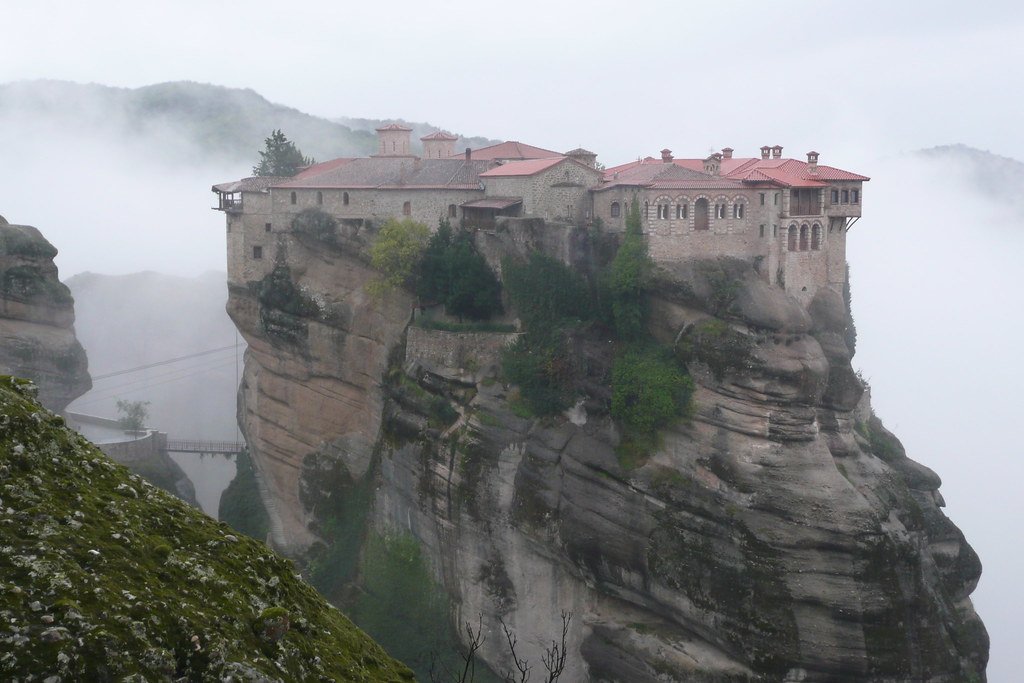
Varlaam sits just across from Great Meteoron and is our favorite. It is smaller, warmer, and the frescoes in the katholikon are astonishing. You can still see the original winch tower and the net they used to haul supplies up.
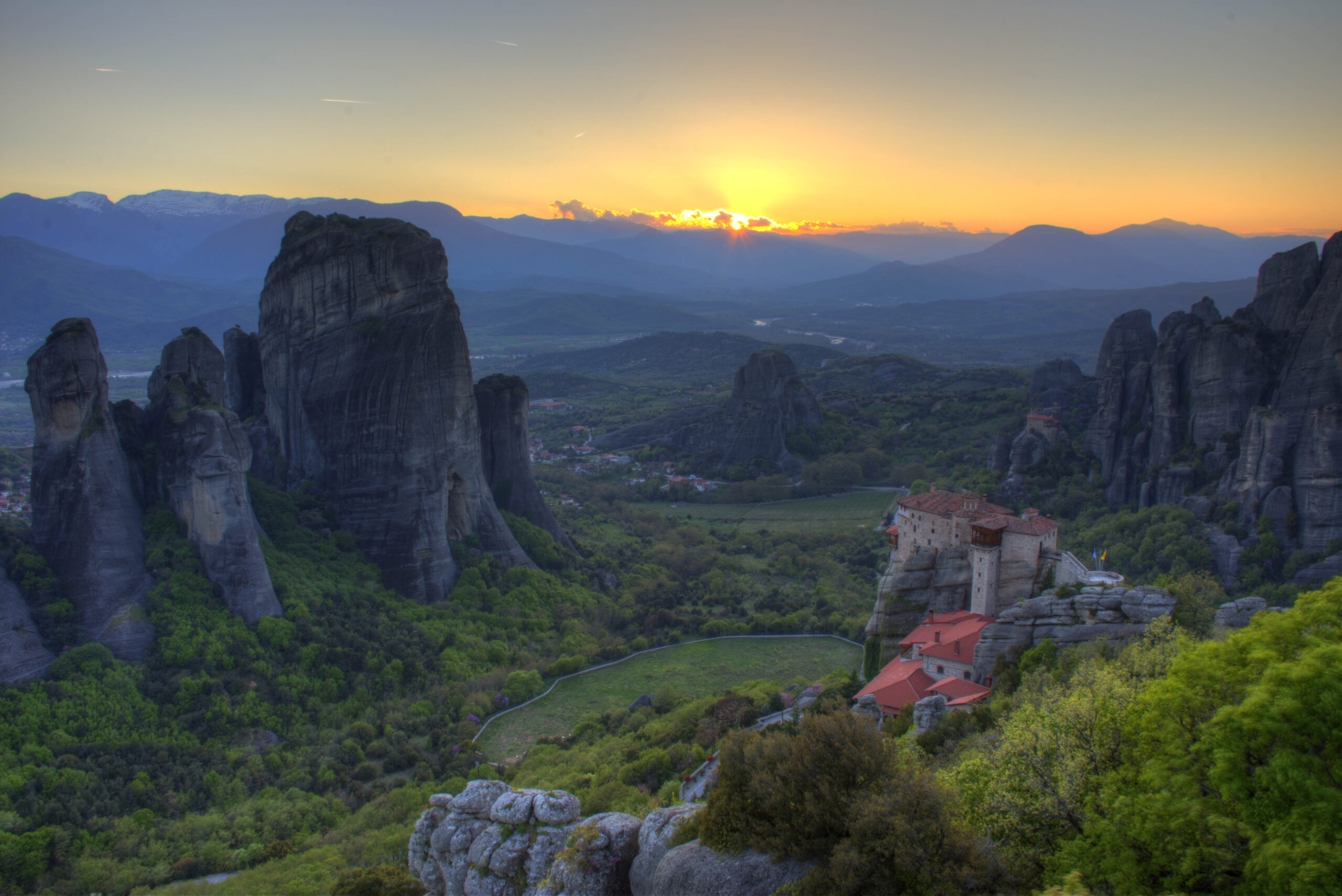
Rousanou is the one in most of the photographs, a compact monastery that appears to be growing directly out of its pillar. It is now a convent, reached by a short footbridge, and it is small enough to fill up fast. Go early.
St Nicholas Anapafsas is the closest to Kastraki and the smallest of the six, built vertically on a narrow rock because there was no room to build outward. Its frescoes were painted by Theophanes the Cretan and are the best art at Meteora. Most tour groups skip it, which is exactly why you should not.
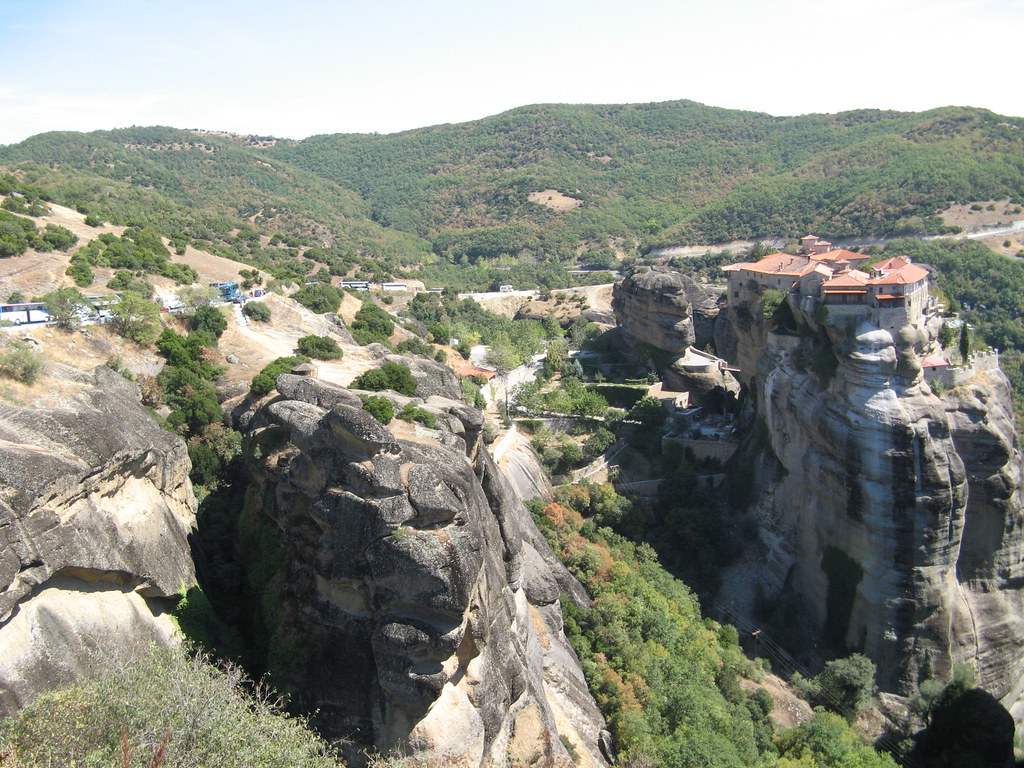
Holy Trinity (Agia Triada) has the most dramatic setting and the longest climb, cut into the rock face. Bond fans will recognize it from For Your Eyes Only. The view back across the plain from the courtyard is the one we think about.
St Stephen is the easiest to reach, a convent crossed by a flat bridge with no significant stair climb. If mobility is a concern, this is the one that works.
The Rules Nobody Warns You About
These are working religious houses, and the dress code is enforced at the door.
Women must wear a skirt covering the knees. Not trousers, not shorts, a skirt. Most monasteries keep a rack of wrap skirts at the entrance you can borrow for free, but they run out at busy times and they are not always clean. Bring your own or pack a long lightweight wrap. Shoulders covered too.
Men need long trousers. Shorts will get you turned away. Shoulders covered.
Each monastery closes one day a week, and the closing day is different for each one, and the schedule changes between summer and winter. Check the current days before you plan your route, because building a day around Varlaam and arriving on its closed day is a genuinely common mistake.
Entry is about 5 euros per monastery, cash, per person. Bring small notes.
No photography inside the churches. Outside is fine.
The Hikes, Which Are the Best Part
Almost everyone drives the loop road, stops at the parking lots, climbs the stairs, and leaves. The old monk paths are still there and they are free, quiet, and better.
The path from Kastraki up to Great Meteoron climbs through the rocks on the original trail, takes about an hour, and delivers you to the monastery from below rather than from a car park. This was the best two hours of our visit.
The Doupiani rock loop above Kastraki is short, easy, and gives you the classic view of the pillars with the village underneath.
The Holy Trinity approach from Kalambaka is a proper trail, about 45 minutes uphill, and it is how the monks got there for six hundred years.
Wear real shoes. The sandstone is smooth and slick, and there are drops without railings.
Sunset and Sunrise
Meteora is one of the few places where the light genuinely changes the experience.
Sunset is best from the observation deck near Rousanou, sometimes called Psaropetra, on the loop road. It gets crowded, so arrive 40 minutes early. The rock turns orange and the monasteries go into silhouette.
Sunrise is better and almost empty. The viewpoint above Kastraki looking toward Holy Trinity, or the terrace near St Stephen, both work. Morning mist pooling in the valley below the pillars is the image everyone hopes for, and it is most likely in spring and autumn.
Where to Stay: Kalambaka or Kastraki
Kalambaka is the larger town, with the train station, most of the hotels, plenty of tavernas, and pharmacies and ATMs. It sits at the base of the rocks and many rooms have direct rock views. It is the practical choice, especially without a car.
Kastraki is a small village tucked right underneath the pillars, about a mile from Kalambaka. It is quieter, prettier, closer to the hiking trailheads, and where we would stay again. Fewer restaurants, but the ones there are good.
Either way, pay for the room with the view. It costs very little more and you will sit on that balcony every evening.
Getting There and Getting Around
By train from Athens is the easy option and the one we recommend. It takes roughly four and a half to five hours, sometimes with a change at Paleofarsalos, and drops you in the center of Kalambaka. The last stretch through the plain with the rocks appearing is worth the ticket by itself.
By train from Thessaloniki is about three to four hours with a change.
By car from Athens is about four and a half hours. A car is genuinely useful once you are there, because the monastery loop road covers real distance and there is no public transport on it worth using.
Without a car, local buses run from Kalambaka up to the monasteries a few times daily in season, taxis are affordable for the loop, and half-day guided monastery tours from Kalambaka solve the problem entirely. Between the hiking trails and one taxi loop, we know people who have done Meteora perfectly well car-free.
Many people combine Meteora with Delphi as a mainland road trip out of Athens, which is a strong four to five day itinerary and a good counterweight to island time.
A Two-Day Meteora Itinerary That Works
This is the plan we would use if we went back tomorrow.
Day one. Arrive by lunchtime and eat in Kastraki. In the afternoon, walk the Doupiani rock loop to orient yourself, which takes about an hour and shows you the whole formation from below. Visit St Nicholas Anapafsas late in the day, because it is closest, smallest, and has the best frescoes, and the tour coaches will have gone. Finish at the Rousanou observation deck for sunset.
Day two. Start early on the old monk path from Kastraki up to Great Meteoron. Do Great Meteoron when it opens, then walk five minutes across to Varlaam, which is the pairing that makes the most sense geographically. Break for lunch back in town. In the afternoon, drive or taxi the far end of the loop to Holy Trinity and St Stephen, and if the weather is good, stay up there until the light goes.
If you have a third day, spend it hiking rather than adding monasteries. The trails between the pillars, past the hermit caves and the old rope-ladder sites, are where Meteora stops being a viewpoint and starts being a place.
Eating in Kalambaka and Kastraki
This is Thessaly, not the islands, and the food changes with it. Expect more grilled meat, more slow-cooked stews, and local sheep and goat cheeses instead of seafood.
Look for kontosouvli and gyros done properly over charcoal, hilopites (the regional egg noodle) served with cheese or in a stew, and tsipouro, the Thessalian spirit, which arrives with small plates of meze whether you ordered them or not.
Kastraki has fewer places but the ones under the rocks with terraces are the ones you want at dinner. Kalambaka has more range, including a handful of genuinely good modern Greek kitchens near the central square. Either way, dinner for two with wine runs 30 to 45 euros, which after the islands feels like a rebate.
One practical note: kitchens here close earlier than in Athens or on the islands, and in the off season some stop serving by 9pm. Do not roll up at 9:30 expecting to be fed.
Where to Book
- Hotels and guesthouses: Search Meteora and Kalambaka stays on Booking.com. Filter for rock views, and book early for spring and autumn weekends, because the good balconies in Kastraki are a small inventory.
- Tours and activities: Browse Meteora tours on Viator. Sunset monastery tours, guided hiking on the old monk paths, half-day monastery circuits with transport, and day trips from Athens or Thessaloniki are all bookable, and a guide who can read the frescoes changes what you get out of the interiors.
If you are pricing the whole trip, our breakdown of what a trip to Europe costs is a useful sanity check against the Greece numbers.
What Meteora Costs
Meteora is one of the better value destinations in Greece because the main attraction is essentially free.
- Mid-range hotel with a rock view: 70 to 120 euros a night
- Taverna dinner for two with wine: 30 to 45 euros
- Monastery entry: about 5 euros each, so 30 euros total for all six
- Half-day guided monastery tour: 30 to 50 euros per person
- Taxi loop of the monasteries: roughly 50 to 70 euros for a few hours
Two people can do Meteora well on 130 to 180 euros a day. It is noticeably cheaper than the islands.
When to Go
April to early June and mid-September to October are the best windows. Comfortable hiking temperatures, green plain in spring, and the morning mist that makes the photographs.
July and August are hot, often over 95 degrees, and the stairs are brutal in that heat. It is also peak coach-tour season. If you must go in summer, be at the first monastery when it opens and be done by 11am.
November to March is cold and quiet, and the monasteries keep shorter hours, but low cloud drifting between the pillars is genuinely spectacular and you will have the place almost to yourself. Bring layers.
Our guide to the best time to visit Greece has the full month-by-month picture.
What We Would Do Differently
We gave Meteora one full day and a half. It needed two full days, and we knew it by lunchtime on the first.
We also did the monasteries by car before we did any hiking, which meant we saw the best views from a parking lot first. Reverse it. Hike up on the first morning, then use the car for the far monasteries afterward.
And we did not check the closing days properly, which cost us St Nicholas Anapafsas, the one with the best frescoes on the whole site. Look it up the week before you go.
Keep planning your Greece trip: Start with our complete guide to planning a trip to Greece for itineraries that combine the mainland with the islands, then read our Athens travel guide for the city you will fly into, and our Crete travel guide if you want an island with the same appetite for driving and hiking.