Disclosure: This post contains affiliate links. If you book through our links, we may earn a small commission at no extra cost to you. Thanks for supporting Faceted Travel!
Table of Contents
- What Èze Actually Is
- The Jardin Exotique: Pay the Fee, Every Time
- The Village Lanes: Galleries, Doorways, and Getting Pleasantly Lost
- The Nietzsche Path: Earn Your Village
- Timing Is Everything
- Where to Eat
- Getting There Without a Car
- Should You Stay Overnight?
- Practical Tips We Wish We’d Known
- Where to Book
- Our Honest Take
There is a moment on the walk up through Èze, somewhere between the second art gallery and the cactus garden at the top, when you round a corner and the entire Mediterranean opens up 1,400 feet below you, and everyone, absolutely everyone, stops walking. We watched it happen to a dozen strangers in a row: the mid-sentence pause, the slow turn, the reach for the phone. Èze does this to people. It is a medieval stone village stacked on a cliff between Nice and Monaco, and it may hold more concentrated beauty per square foot than anywhere else on the French Riviera.
It is also tiny, wildly popular in the middle of the day, and easy to do wrong. We have now visited twice, once badly and once well, and this guide is the difference between those two trips.
What Èze Actually Is
Èze (pronounced “ezz”) is a perched village, one of the fortified hilltop towns built along this coast when danger came from the sea. The old village is entirely pedestrian: a tight spiral of cobbled lanes, stone archways, bougainvillea, and honey-colored houses that climbs from the road to the ruins of a castle at the summit, now home to the famous Jardin Exotique cactus garden. Below it, way below it, is Èze-sur-Mer, the little beach settlement on the coast, connected to the village by a steep and gorgeous walking trail.
The whole old village can be crossed in ten minutes if you are rude about it. The point is not to cross it. The point is to drift, look up a lot, and let the lanes do what they were designed to do, which is slow everybody down.
The Jardin Exotique: Pay the Fee, Every Time
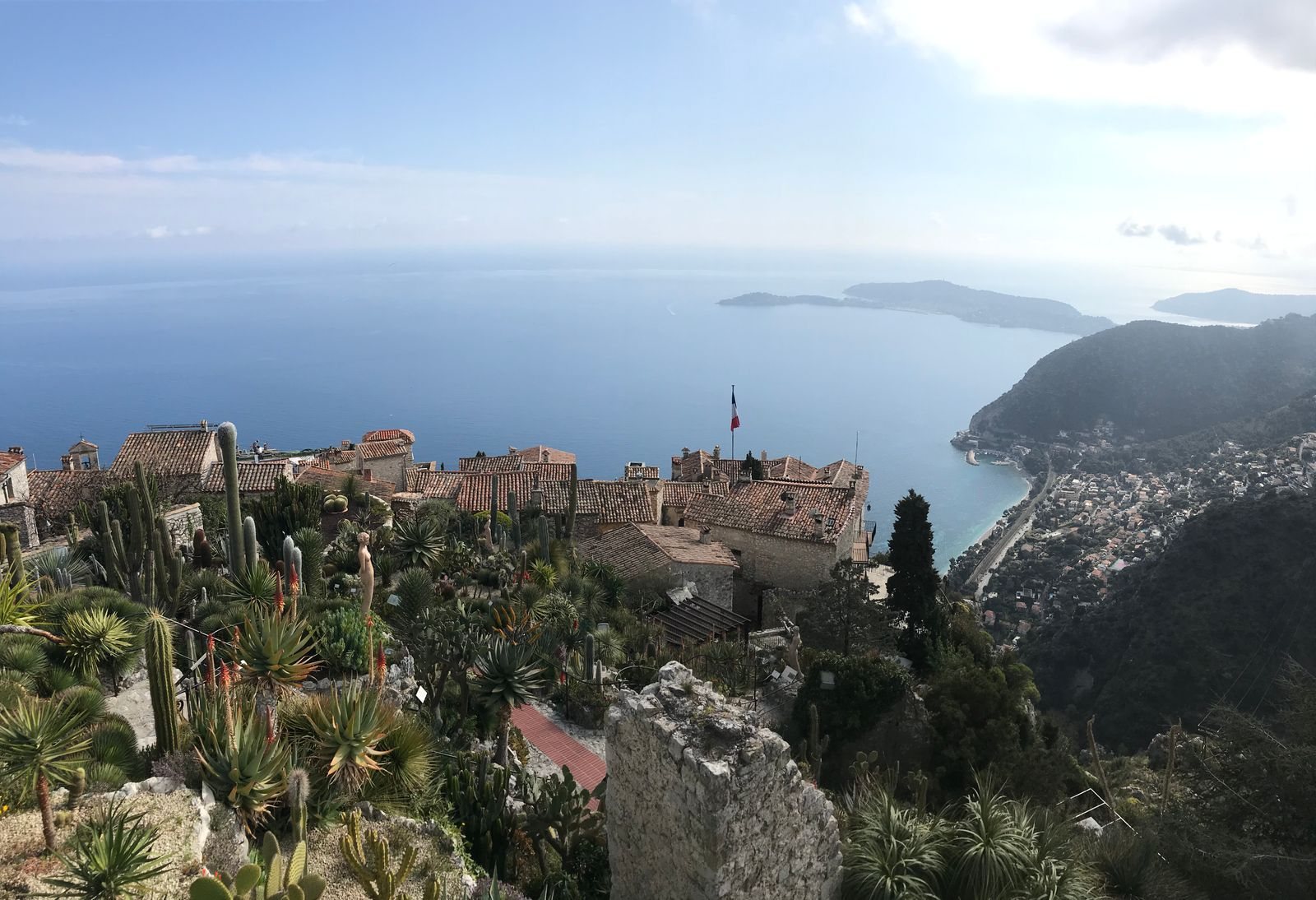
At the very top of the village, planted among the castle ruins, is the Jardin Exotique d’Èze, a cactus and succulent garden threaded with paths, sculptures, and quiet corners. On our first visit we almost skipped it because a garden entry fee on top of a free village felt unnecessary. That would have been a genuine mistake, because the garden is not really about the cacti. It is about the view: a full panorama from Cap Ferrat to the Esterel, with the sea shading from turquoise at the shore to deep navy at the horizon, and sailboats reduced to white commas below you.
Go all the way to the highest terrace. Sit on the bench. Stay longer than feels productive. This is the single best viewpoint on the Riviera that does not require a hike, and we say that having done the hikes.
The Village Lanes: Galleries, Doorways, and Getting Pleasantly Lost
Èze’s permanent population is only a few dozen people in the old village itself, and most of the buildings now house small galleries, artisan shops, and perfumeries. Yes, it is polished for visitors. It is also done with more taste than most famous villages manage: no plastic souvenir bins, lots of actual working artists, and enough unmarked side stairways that you can still find a corner alone with a cat and a view.
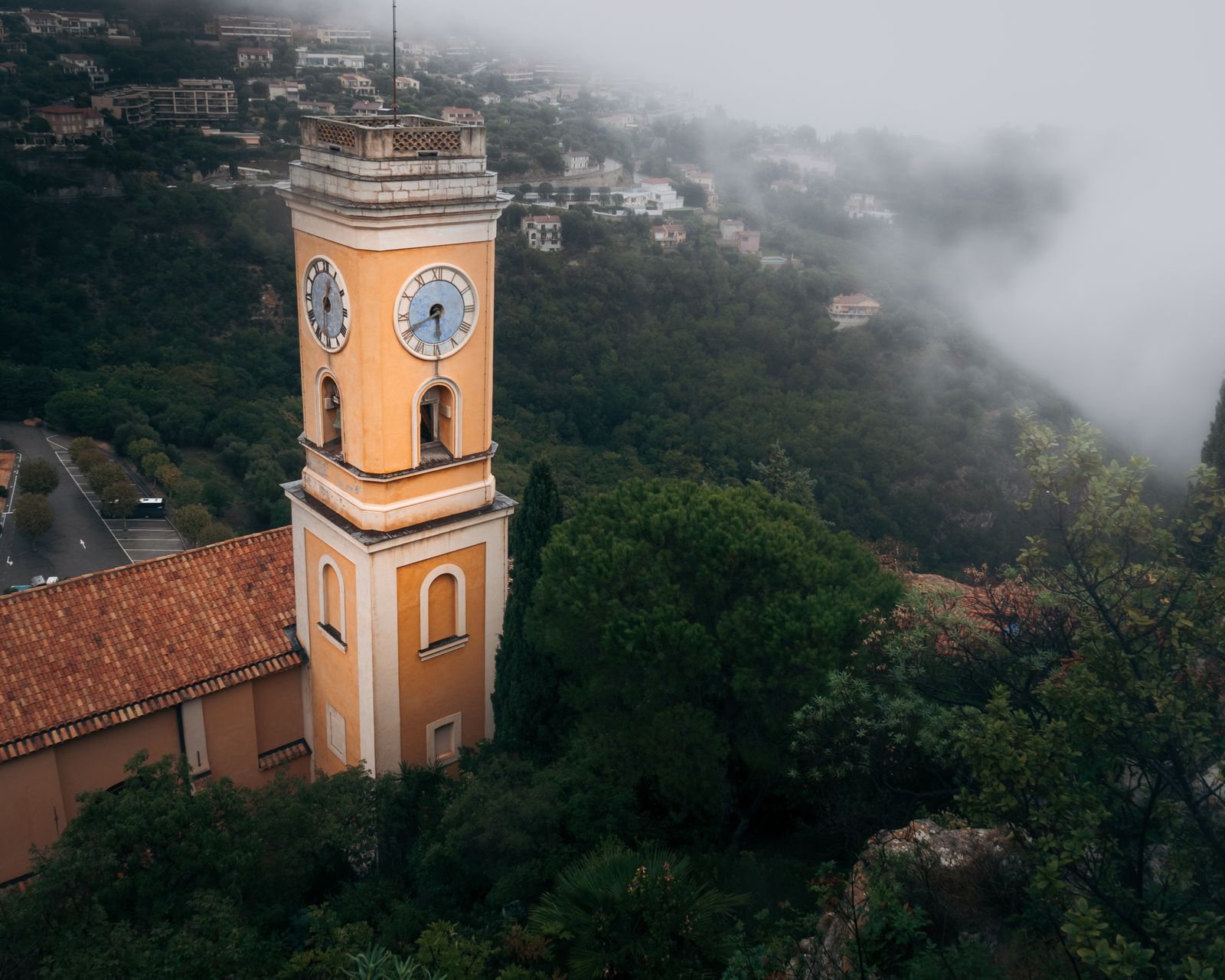
Two specific stops earned our affection. The Fragonard perfume factory at the village entrance runs free tours that are genuinely interesting (Èze sits in the orbit of Grasse, the perfume capital of the world), and the tiny chapel of Sainte-Croix, the oldest building in the village, is usually empty and lovely. Beyond that, our sincere advice is to put the map away. The village is too small to get truly lost in and too pretty to rush.
The Nietzsche Path: Earn Your Village
Friedrich Nietzsche used to climb from the coast up to the village while wintering here, and the trail he walked, now the Chemin de Nietzsche, is the best thing we did in Èze. It drops from the old village down to Èze-sur-Mer through pines, rock, and increasingly outrageous sea views, taking 45 minutes to an hour down and a sweaty 60 to 90 minutes up.
Our recommendation: take the bus or train to Èze-sur-Mer in the morning and climb up while the light is soft and the day is cool, then reward yourself in the village. Wear real shoes (the path is rocky and steep, not technical but not flip-flop territory), carry water, and skip it entirely in wet weather when the stones get slick. Arriving in Èze on foot, through the back gate as it were, beats stepping off a tour bus by an unquantifiable margin.
Timing Is Everything
Here is the honest part: between roughly 11am and 4pm in high season, Èze is overwhelmed. The village’s lanes are narrow enough that two tour groups constitute a traffic jam, and the magic gets hard to feel over the shuffle.
The fix is simple, because the crowds are day-trippers on a schedule. Come before 10am or after 5pm and the village empties into something close to private. Our second visit, we arrived at 8:30am on a June morning: empty lanes, cool air, the garden nearly to ourselves, and by the time the first big groups puffed up the hill at 11, we were sitting under an awning with coffee watching it all like locals. Evening is even better if you stay for dinner, when the stone glows gold and the coast lights come on below.
Seasonally, May, June, September, and October are the Riviera’s sweet spots: warm, bright, and breathing room everywhere. July and August are hot and maximally crowded. Winter is quiet and often sunny, with some restaurants closed but the views entirely intact.
Where to Eat
Èze village has a surprising density of good food for its size, anchored by two of the Riviera’s most famous hotel restaurants: La Chèvre d’Or, with two Michelin stars and a terrace that may be the most beautiful dining room in France, and Château Eza, whose clifftop terrace serves a (relatively) accessible lunch with the same impossible view. Neither is cheap. One long lunch at Château Eza was our splurge of the trip, and months later it is the meal we still bring up.
For normal budgets, the cafés around the village entrance and Place du Planet do solid Niçoise standards (salade niçoise, socca, daube), and down at Èze-sur-Mer a couple of relaxed beach restaurants serve grilled fish a few steps from the water. There is no supermarket in the old village, so if you want picnic supplies for the Nietzsche Path, bring them from Nice.
Getting There Without a Car
Èze is one of the easiest Riviera villages to reach by public transport, which is good, because parking is scarce and the corniche roads in summer are a patience exercise.
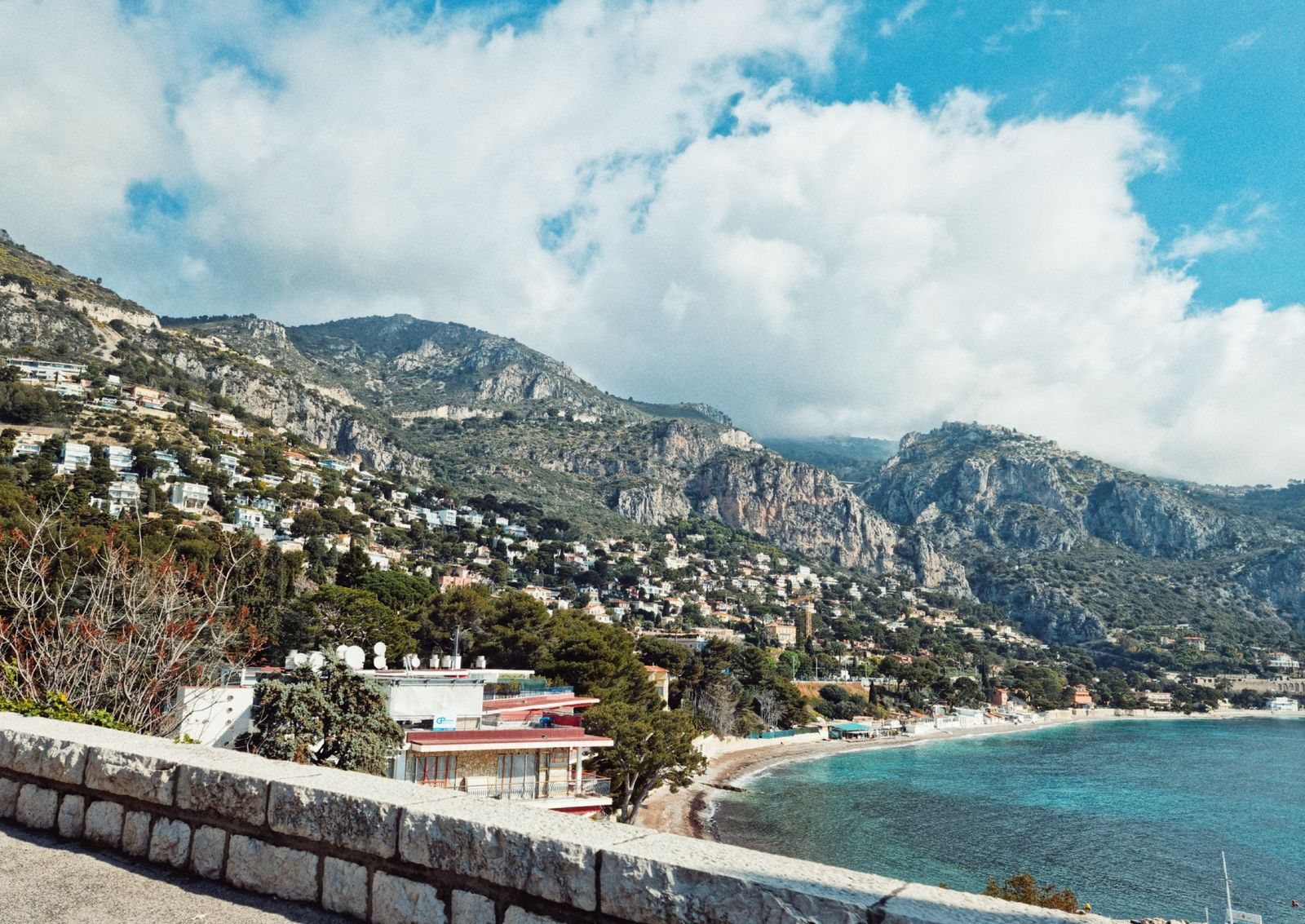
From Nice, bus 82 (with some 112 services) climbs from the port area to Èze village in about 25 to 30 minutes, and the ride along the Moyenne Corniche is a scenic attraction in itself; sit on the right side heading east. Alternatively, the coastal train from Nice or Monaco stops at Èze-sur-Mer down on the water, from which you either climb the Nietzsche Path or catch the little connecting bus 83 up the hill. Monaco is 15 minutes further east, which makes Èze a perfect half-day pairing with the principality.
If you are driving a wider Riviera loop, Èze slots neatly between Nice and Monaco on the Moyenne Corniche, with Antibes and Cannes an easy 45 to 60 minutes west. Arrive before 9:30am if you want a parking spot without a story attached.
Should You Stay Overnight?
Most people do Èze in two to four hours from Nice, and that works. But the village transforms after the day crowds leave, and the two clifftop hotels (plus a handful of small guesthouses nearby) make an overnight possible. If your budget allows even one splurge night on the Riviera, this is a strong place to spend it: sunset and sunrise from the cliff, dinner in the gold-lit lanes, and the village to yourself at both ends of the day. If the splurge is not in the cards, base in Nice and day-trip smart with an early start; the town pairs beautifully as a base, as we cover in our Nice, France travel guide.
Practical Tips We Wish We’d Known
A few small things make an outsized difference here. Wear grippy shoes even if you skip the Nietzsche Path, because the village lanes themselves are polished stone, steep, and slick after rain. Bring a card for the garden but some cash for the smaller galleries. Bathrooms are scarce; use the ones near the village entrance before you climb. If you are mobility-limited, know that Èze is essentially stairs with scenery, and the best accessible option is the lower terrace of the garden plus the corniche viewpoints by car.
And manage the photography honestly: the light on the coast is best before 10am (soft, blue water) and in the last two hours before sunset (gold stone). Midday sun flattens the sea to glare, which is one more argument for arriving at the edges of the day. The classic shot, the village silhouette on its cone of rock, is actually taken from the Moyenne Corniche road just west of town, so grab it from the bus window or the roadside pullout before you arrive.
Where to Book
- Hotels: Booking.com’s Èze listings cover the clifftop icons and the more affordable options down at Èze-sur-Mer and along the corniche; for a summer overnight at the famous properties, book four to six months ahead. Staying in Nice and day-tripping is the budget play, with far more choice.
- Tours and activities: Viator’s French Riviera tours include half-day and full-day trips combining Èze with Monaco and Monte Carlo, perfume workshop visits at Fragonard, and private driver loops along the three corniche roads, which is the easiest way to see the whole coast in a day if your time is short.
Our Honest Take
Èze walks a line that few famous villages manage: it is unapologetically a showpiece, and it is still, somehow, the real thing. Stone that old and a view that big cannot be faked, and no crowd can fully drown them out. Go early or stay late, pay for the garden, climb the Nietzsche Path if your knees will sign off on it, and give the place three more hours than the tour buses do. We have seen a lot of beautiful corners of France at this point, and the top terrace of Èze at 9am, with the whole Mediterranean lit up below and nobody else on the bench, is still in our top five anywhere.
Doing the Riviera properly? Pair Èze with our Nice, France travel guide for the perfect base city, our Antibes, France travel guide for the coast’s best old town and beaches, and our How to Plan a Trip to France guide to stitch the whole country together.