Disclosure: This post contains affiliate links. If you book through our links, we may earn a small commission at no extra cost to you. Thanks for supporting Faceted Travel!
We walked into the Mezquita at 8:30 in the morning expecting to spend an hour, and came out two and a half hours later having barely spoken to each other. Some buildings you visit; this one you stand inside while it quietly rearranges your sense of what architecture can do.
Table of Contents
- Why Córdoba Deserves More Than a Day Trip
- The Mezquita: One of the Great Buildings of the World
- Beyond the Mezquita
- The Patios: Córdoba’s Living Tradition
- What to Eat in Córdoba
- Where to Stay
- When to Go
- Getting There and Getting Around
- A Perfect Day and a Half in Córdoba
- Tips for First-Timers
- Where to Book
- Our Honest Take
Córdoba gets treated as a day trip from Seville, and after two nights there we think that is one of Spain’s great travel injustices. This guide covers the Mezquita (and how to see it without the crowds), the patios and the old Jewish quarter, where to eat salmorejo until you need a nap, and why an overnight stay beats the day-trip rush every time.
Why Córdoba Deserves More Than a Day Trip
A thousand years ago, Córdoba was arguably the largest and most sophisticated city in Western Europe: capital of the Islamic caliphate of al-Andalus, home to philosophers, libraries, and street lighting while most of the continent was living in the mud. That golden age left behind the Mezquita, a mosque-cathedral that belongs on any shortlist of the most extraordinary buildings on earth, plus a tangle of whitewashed lanes, hidden courtyards, and a food culture built for the Andalusian heat.
The day-trip crowds flood in from Seville and Madrid around 10:30am and drain away by 6pm. Stay the night and you get the two best versions of the city: the Mezquita at opening time with the tour groups still on their buses, and the old town in the evening when the lanes are lamplit, the plazas fill with locals, and the temperature finally drops into pleasant.
The Mezquita: One of the Great Buildings of the World
What you are looking at
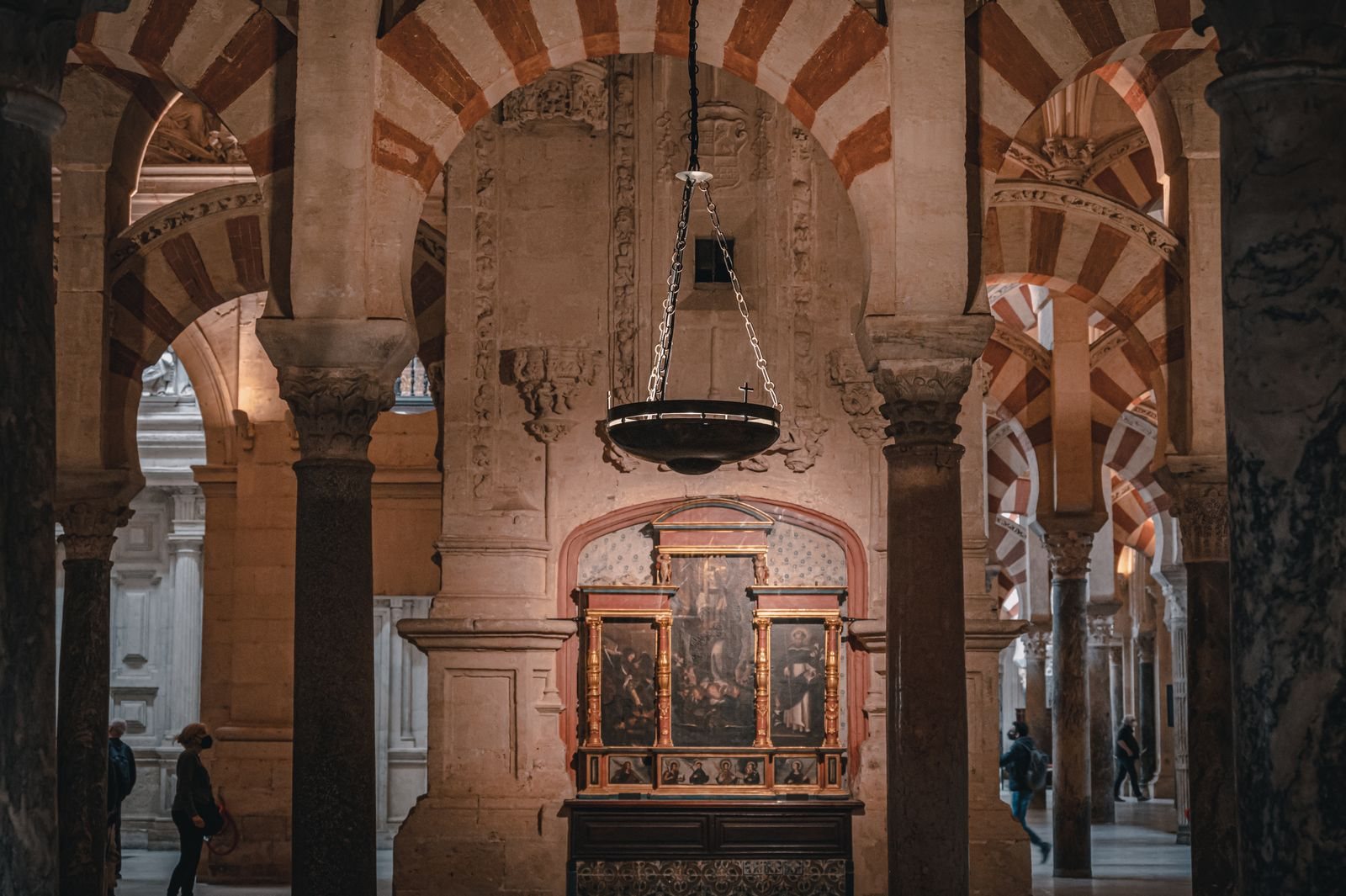
The Mezquita-Catedral began as an 8th century mosque and grew over 200 years into a forest of more than 850 columns topped with double horseshoe arches in candy stripes of red brick and white stone. After the Christian reconquest, rather than tearing it down, the new owners planted a full Renaissance cathedral in the middle of it. The result is a building that argues with itself in the most beautiful way possible: you walk through dim, endless arches and suddenly emerge into a soaring white nave flooded with light, then step back into the arches again.
How to visit it right
- Go at opening. General tickets start at 10am, but Monday through Saturday there is free entry from 8:30 to 9:30am for individual visitors (no groups allowed). It is the best free hour in Spain: the arches nearly empty, the light low and gold.
- Book the bell tower (the old minaret) for views over the rooftops and the Roman bridge.
- Give it two hours minimum. The mihrab, with its gold mosaic dome, rewards slow looking.
- Dress with shoulders covered; it is an active cathedral.
The Patio de los Naranjos
The courtyard of orange trees outside the Mezquita is free, shaded, and scented with citrus for much of the year. It has been the building’s forecourt for over a millennium and is the right place to sit and process what you just walked through.
Beyond the Mezquita
The Judería (old Jewish quarter)
The lanes north of the Mezquita are the Córdoba of the postcards: whitewashed walls, wrought-iron window grilles, and flowerpots bolted to every vertical surface. Find the Calleja de las Flores early or late (it is a one-photo alley and fills fast), then get purposefully lost. The tiny 14th century synagogue, one of only three medieval synagogues left in Spain, is a moving five-minute visit.
The Alcázar de los Reyes Cristianos
Córdoba’s fortress-palace is where Ferdinand and Isabella planned the final push against Granada and where Columbus pitched his voyage. The building is austere; the gardens are the show: terraced pools, cypress avenues, and beds of roses running down to the river. Go in the last two hours of the day when the stone glows.
The Roman bridge and Calahorra Tower
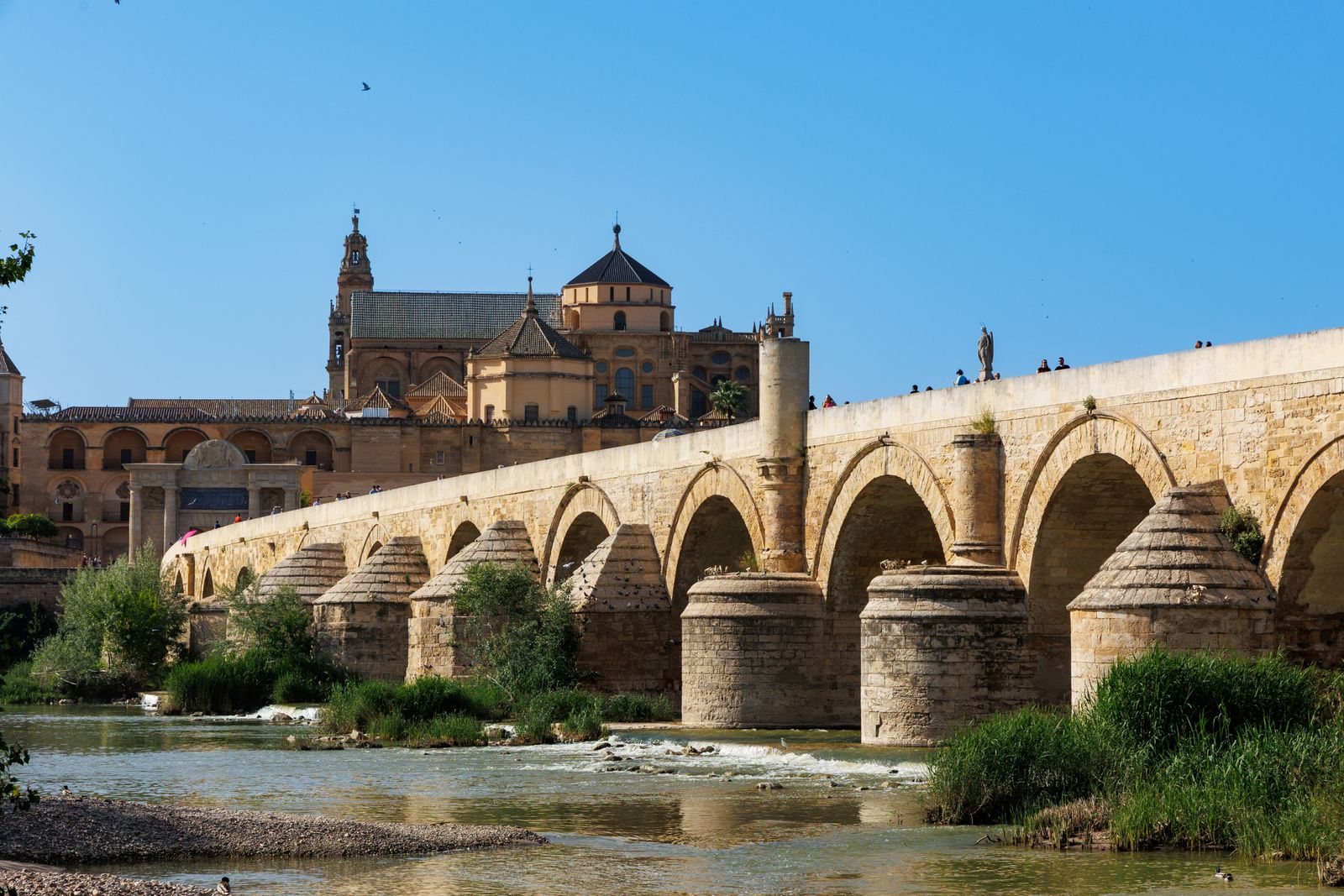
The 16-arch Roman bridge has spanned the Guadalquivir for 2,000 years, and walking it at sunset with the Mezquita glowing behind you is Córdoba’s signature evening. Game of Thrones used it as the Long Bridge of Volantis, which will delight exactly half of any couple.
Palacio de Viana (for patio lovers)
Twelve courtyards in one aristocratic house, each in a different style, each impeccably kept. If you visit outside patio festival season, this is where you see what the fuss is about.
Medina Azahara: the ruined city in the hills
Twenty minutes west of town lie the ruins of Medina Azahara, the palatial capital the caliph Abd al-Rahman III built in the 10th century to outshine every court in Europe, and which was sacked and abandoned barely 70 years later. What survives, arches, reception halls, and terraced foundations spilling down the hillside, only hints at what contemporary visitors described as walls shimmering with gold and pools of mercury that scattered sunlight across the ceilings. It is UNESCO-listed, hauntingly quiet compared with the Mezquita, and easily reached by a dedicated tourist bus from the city center (the site museum at the entrance is excellent and free with your ticket). Give it half a day, take water in summer, and go in the morning before the heat builds on the exposed hillside.
The Patios: Córdoba’s Living Tradition
Every May, Córdoba holds the Fiesta de los Patios, when private homeowners fling open their courtyards, wall-to-wall with geraniums, jasmine, and carnations, and compete for the title of most beautiful patio. The festival is UNESCO-listed, free to wander, and utterly charming, though the city books out months ahead. Outside May, several patios in the San Basilio quarter stay open year-round for a small fee, and they are well worth an hour.
What to Eat in Córdoba
Córdoba’s kitchen is built for heat and history, and it is cheaper than Seville’s across the board.
- Salmorejo: the city’s dish, a thick chilled purée of tomato, bread, olive oil, and garlic topped with ham and egg. Creamier and better (we said it) than gazpacho.
- Flamenquín: a rolled, breaded pork-and-ham log, fried and enormous. Split one.
- Berenjenas con miel: crispy fried eggplant with cane honey, the tapa we ordered at every stop.
- Rabo de toro: slow-braised oxtail, the winter heavyweight, served year-round in the old town.
- For the classic experience, eat at one of the old taverns (Taberna Salinas and Bodegas Campos are institutions) and finish with a glass of chilled Montilla-Moriles, the local sherry-style wine that never made it famous and is better for it.
Where to Stay
- Judería / around the Mezquita: atmospheric and central, with boutique hotels tucked into old courtyard houses. Ask for an interior room; the lanes echo at night.
- San Basilio (Alcázar quarter): quieter, whitewashed, home to the year-round patios, and still five minutes from everything. Our pick.
- Near Plaza de las Tendillas: the modern center, better value, and closer to where locals actually eat, a 12 minute walk to the Mezquita.
Prices run noticeably below Seville and Granada: a lovely boutique double often costs what a plain three-star does elsewhere in Andalusia. May (patio festival) is the exception; book that far ahead.
When to Go
Spring is Córdoba’s headline act: April and May bring orange blossom, the patio festival, and warm, perfect evenings. September and October are the mellow second season. July and August are brutally hot, regularly over 40°C (104°F); Córdoba sits in a river basin and is reliably the hottest city in Spain, so if you must come in summer, structure your days like a local (sights at 8:30am, siesta, dinner at 10pm). Winter is mild, quiet, and underrated, with the Mezquita blissfully uncrowded. For the wider picture, our guide to the best time to visit Spain breaks down the whole calendar.
Getting There and Getting Around
Córdoba is one of the easiest stops in Spain: it sits on the main high-speed rail line, about 45 minutes from Seville, 1 hour 40 minutes from Madrid, and 1 hour from Málaga. The AVE station is a 25 minute walk or short taxi from the old town. Once you are there, everything worth seeing is on foot; the old town is compact, flat, and largely car-free. If Granada is next on your route, direct trains and buses connect in about 1.5 to 2.5 hours, making the classic Andalusian triangle (Seville, Córdoba, Granada) genuinely effortless.
A Perfect Day and a Half in Córdoba
Arrive in the afternoon, check in at a courtyard hotel in San Basilio, and spend the evening on the Roman bridge at sunset followed by a tapas crawl (salmorejo first, always). Next morning, be at the Mezquita for the 8:30am free hour, climb the bell tower, then wander the Judería while the shops open. Long lunch, proper siesta, then the Alcázar gardens in the golden hour and one last plate of fried eggplant with honey. Train out the following morning, already planning the return.
Tips for First-Timers
- The 8:30am free hour is the whole strategy. It applies Monday through Saturday, individuals only, and no audio guides or groups, which is exactly why it is so peaceful. Arrive by 8:15 and walk straight in.
- Book May far ahead. Patio festival season fills the city’s small hotel stock months in advance, and prices jump accordingly.
- Respect the siesta math. Many sights close or pause in the mid-afternoon, and in summer the streets genuinely empty from 3pm to 6pm. Fighting it is a losing game; nap like a local.
- Day-trippers, check the trains. The last AVE back to Seville and Madrid leaves comfortably late, but the cheap seats sell out on spring weekends.
- Wear real shoes. The old town’s cobbles and polished stones are beautiful and treacherously slippery after rain.
Where to Book
- Hotels: Booking.com’s Córdoba listings are full of converted courtyard houses in the Judería and San Basilio; book two to three months out for spring, and much earlier for the May patio festival.
- Tours and activities: Viator’s Córdoba tours include early-access Mezquita tickets with guides who bring the caliphate era to life, patio walking tours, and day trips from Seville by high-speed train if your itinerary is tight.
Our Honest Take
Córdoba gave us one of the two or three best building visits of our traveling lives, and the city around it is calmer, cheaper, and more genuinely local-feeling than Seville or Granada. It is smaller than both, and a day and a half covers it well, but doing the Mezquita at 8:30am instead of 12:30pm is the difference between a masterpiece and a queue. Stay the night. You will feel smug about it, and you will be right.
Building an Andalusia route? Pair this with our Seville travel guide and Granada travel guide, and map the whole journey with our guide on how to plan a trip to Spain.