Disclosure: This post contains affiliate links. If you book through our links, we may earn a small commission at no extra cost to you. Thanks for supporting Faceted Travel!
Table of Contents
- What Is Butrint?
- How to Get to Butrint
- Tickets, Hours and Practical Info
- What to See at Butrint
- Tips for Visiting Butrint
- Where to Stay Near Butrint
- What Else to See Nearby
- Best Time to Visit Butrint
- How Butrint Fits into an Albania Itinerary
- How Much Does It Cost to Visit Butrint?
- Where to Book
- Final Thoughts
Imagine wandering through a 2,500-year-old Greek theater, a Roman bathhouse and a Byzantine basilica, all shaded by eucalyptus and laurel trees, with frogs croaking in the ruins and a turquoise lagoon glinting through the forest. That is Butrint, and it was one of the most magical mornings of our entire Albania trip.
Butrint is Albania’s most important archaeological site and a UNESCO World Heritage Site, and it sits just a few minutes south of Ksamil on the Albanian Riviera. If you are spending any time around Saranda or Ksamil, or even hopping over from Corfu, this is the one day trip you should not skip. Here is everything you need to know to plan your visit.
What Is Butrint?
Butrint is an ancient city on a small, wooded peninsula surrounded by Lake Butrint and the Vivari Channel, which connects the lake to the Ionian Sea. People have lived here for roughly three thousand years, and almost every major Mediterranean power left something behind:
- Greeks founded a settlement here and built a sanctuary to Asclepius, the god of healing.
- Romans expanded it into a colony, with baths, houses, a forum and an aqueduct.
- Byzantines added churches, including the stunning baptistery and the Great Basilica.
- Venetians built fortifications and towers to control the channel.
- Ottomans and the local ruler Ali Pasha left a triangular fortress at the mouth of the channel.
According to legend, Butrint was founded by refugees from Troy, and the Roman poet Virgil mentions it in the Aeneid. The site was added to the UNESCO World Heritage list in 1992, and the surrounding area is protected as Butrint National Park, which also covers wetlands, lagoons and forests that are home to a lot of birdlife.
What makes Butrint so special is the combination. It is not a dusty field of stones in the sun. The ruins are wrapped in a green, almost jungle-like forest, and the water is always close by. It feels like you have stumbled onto a lost city.
How to Get to Butrint
Butrint is about 18 kilometers south of Saranda and about 5 kilometers south of Ksamil.
By Car
The drive from Saranda takes about 25 to 30 minutes, and from Ksamil about 10 minutes. There is a paid parking lot at the entrance. In peak summer it fills up by mid-morning, which is one more reason to arrive early.
By Bus
Local buses run between Saranda and Butrint, stopping in Ksamil along the way. They depart from the center of Saranda roughly every hour in summer (less often in the off season) and are very inexpensive. Just stand at the bus stop on the main road in Ksamil and flag one down. Check the current schedule with your hotel, as it changes by season.
By Taxi
A taxi from Ksamil is quick and affordable. Agree on the price before you get in, and ask the driver to come back at a set time, since taxis do not always wait at the site.
From Corfu
Butrint is a very popular day trip from Corfu. Ferries run from Corfu Town to Saranda in about 30 minutes to an hour and a half depending on the boat, and many tour operators package the ferry, a guide at Butrint and a stop at the Blue Eye spring into one day. If you are based in Corfu, our Corfu travel guide covers the island itself. Bring your passport, since you are crossing an international border.
Tickets, Hours and Practical Info
- Entrance fee: Paid in Albanian lek at the gate. The price has gone up in recent years, so check the current rate before you go, and bring cash just in case the card machine is down.
- Opening hours: Generally from morning until early evening in summer, with shorter hours in winter. Confirm current hours locally.
- Time needed: Plan at least two to three hours to walk the main loop and see the museum. History lovers can easily spend half a day.
- Guides: Local guides often wait near the entrance. A guide adds a lot of context, since signage is limited.
- Facilities: There is a cafe and restrooms near the entrance, but not inside the ruins.
What to See at Butrint
A well-marked loop trail takes you through the main sites in roughly the order they are listed here. It is mostly flat and shaded, with a short climb up to the acropolis.
The Venetian Tower
Near the entrance, a sturdy stone tower from the Venetian period guards the channel. It sets the tone right away: you are about to walk through many centuries at once.
The Greek Theater
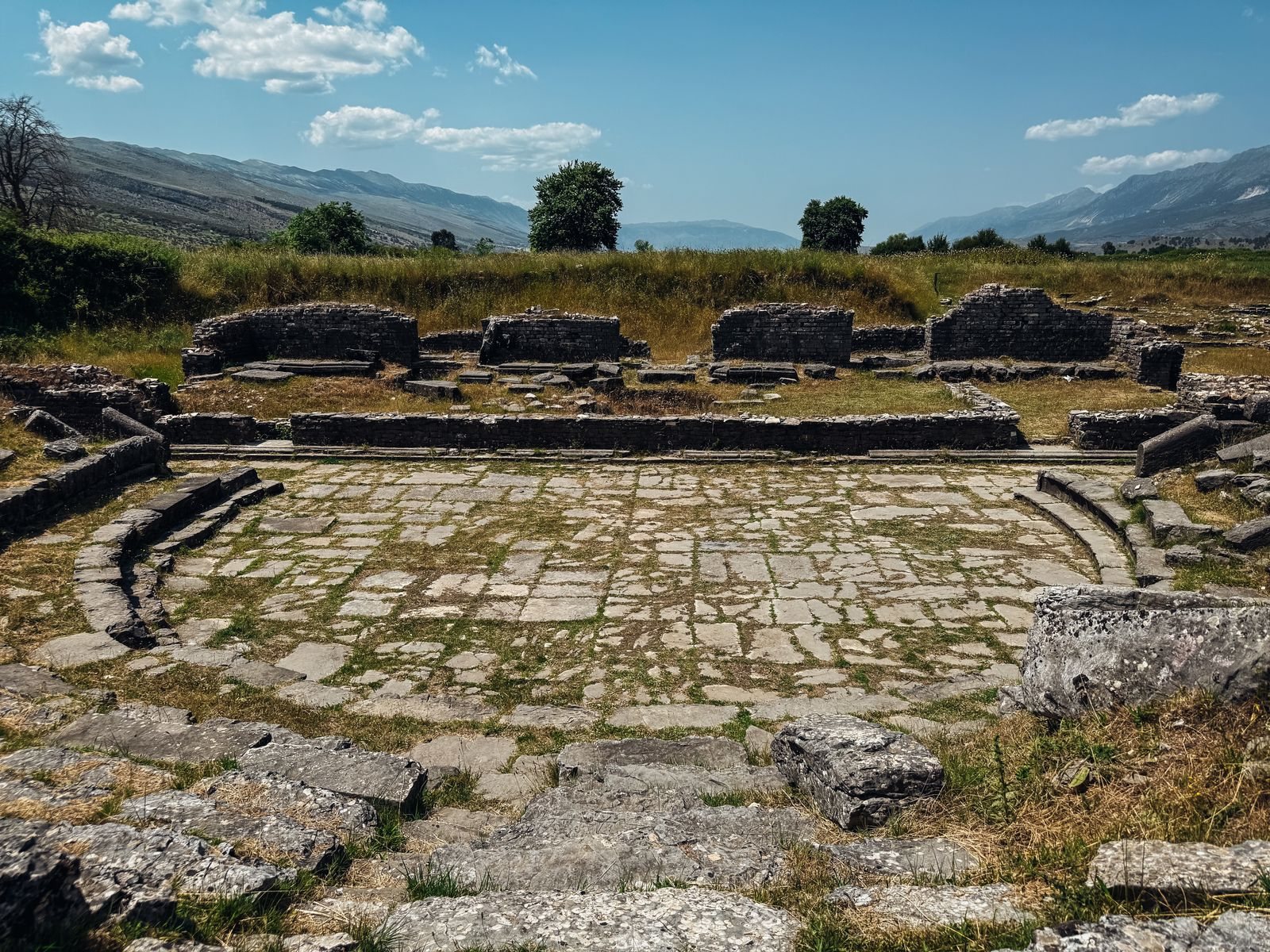
The theater is the highlight for most visitors. It was built into the side of the hill in the Greek period and later expanded by the Romans. Part of the stage area often floods with groundwater, so you may see turtles and frogs swimming around the ancient stones, which is completely delightful. In summer, the theater sometimes hosts performances, and seeing a show here would be unforgettable.
Next to the theater are the remains of the Sanctuary of Asclepius and a small Roman bathhouse.
The Baptistery
The 6th century baptistery is one of the finest early Christian monuments in the Mediterranean. Its circular floor is covered with an intricate mosaic of animals, birds and plants. To protect it, the mosaic is usually kept covered with sand and only revealed occasionally, so do not be disappointed if you only see the columns. The setting among the trees is beautiful either way.
The Great Basilica
The Great Basilica is a large Byzantine church, with tall walls and arched windows still standing. It is one of the most photogenic spots on the site, especially when the late afternoon light filters through the trees.
The Lion Gate
This small gateway in the old city walls has a carved stone relief of a lion attacking a bull above the entrance. It is easy to miss, so keep an eye out as you follow the wall.
The Acropolis and Museum
At the top of the hill, the acropolis is home to a small castle that houses the Butrint Museum. The collection includes statues, coins, pottery and inscriptions found on the site. The real reward, though, is the view from the walls: Lake Butrint on one side, the Vivari Channel and the Greek island of Corfu on the other.
Ali Pasha’s Triangular Castle
Across the Vivari Channel stands a triangular fortress associated with Ali Pasha of Tepelena. A small cable ferry carries cars and people across the channel near the entrance. The castle is worth a look if you have time, and the ferry ride itself is a fun little experience.
Tips for Visiting Butrint
- Go early or late. Arrive when it opens or in the last couple of hours before closing to avoid the heat and the cruise and tour groups.
- Bring bug spray. The wetlands mean mosquitoes, especially near the water in the evening.
- Wear good shoes. The paths are uneven stone and dirt, and some areas can be muddy.
- Carry water. There is nowhere to buy it once you are inside the ruins.
- Watch for wildlife. Turtles, frogs, lizards and lots of birds make the site feel alive.
- Pair it with a swim. Finish your visit with an afternoon on the beaches of Ksamil, just 10 minutes away.
Where to Stay Near Butrint
Most visitors base themselves in Ksamil or Saranda, and both work well for Butrint.
- Ksamil is the closest base, with small islands, clear water and beach clubs. It gets very busy in July and August, but it is lovely in late spring and early fall. Staying here means you can walk to the beach and be at Butrint in minutes.
- Saranda is a bigger town with a long seafront promenade, more restaurants and the ferry port for Corfu. It has more choice at every budget and is better for a longer stay.
We cover the best beaches and where to stay along the whole coast in our Albanian Riviera guide.
What Else to See Nearby
Ksamil Beaches
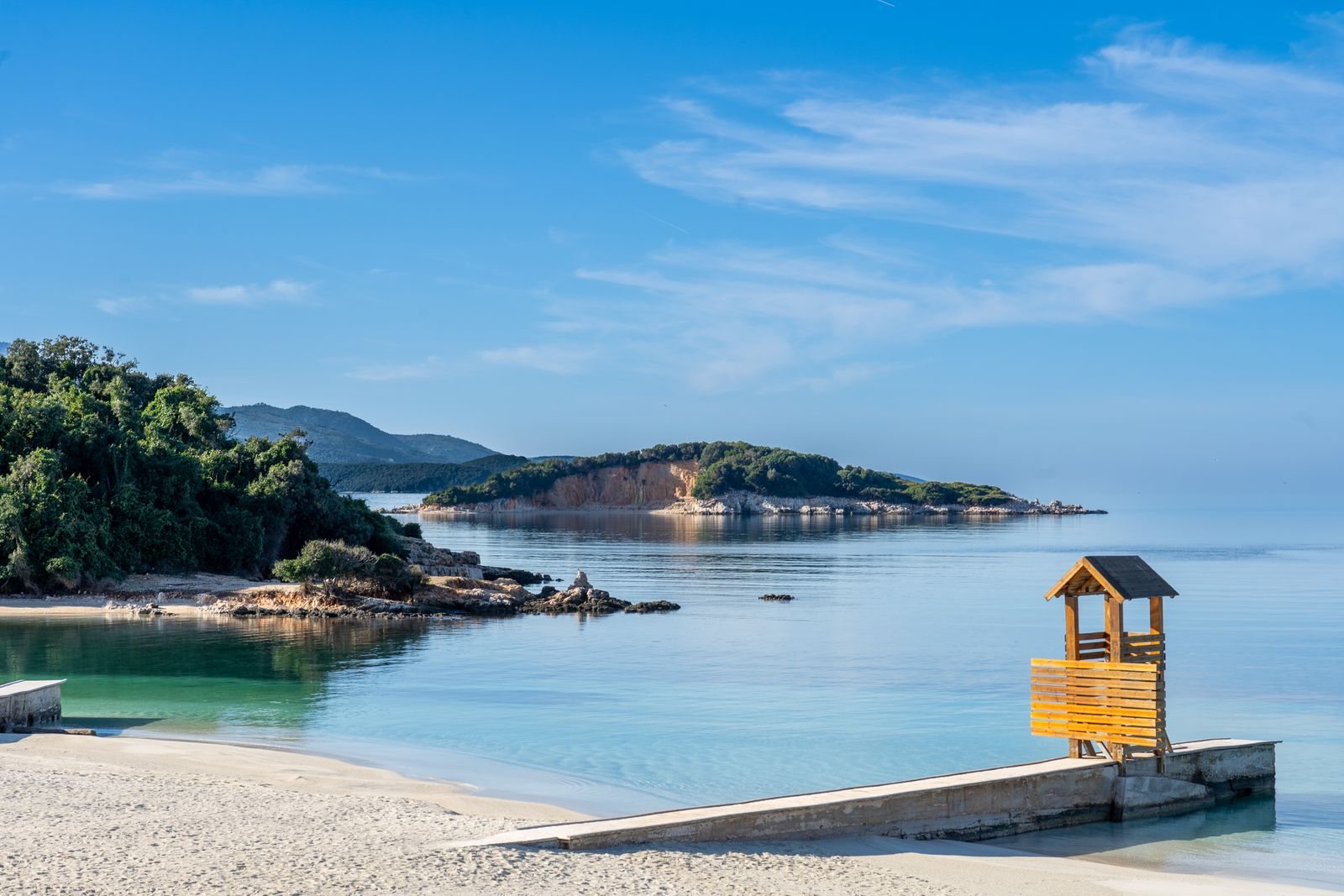
The small beaches and islands of Ksamil are famous for their Caribbean-colored water. Rent a kayak or a pedal boat to reach the islands, or grab a sunbed at one of the beach bars. Go early in peak season, since sunbeds fill quickly.
The Blue Eye (Syri i Kalter)
About 40 minutes inland from Saranda, the Blue Eye is a natural spring where water bubbles up from a depth of more than 50 meters, creating an unreal deep blue pool in the middle of the forest. It pairs perfectly with Butrint on a full day of sightseeing.
Lekuresi Castle
Perched on a hill above Saranda, Lekuresi Castle has a restaurant with panoramic views over the town, the sea and Corfu. It is the classic sunset spot in Saranda.
Gjirokaster
About an hour and a half from Saranda, the UNESCO stone town of Gjirokaster makes an excellent next stop. Read our guide to Berat and Gjirokaster for the details.
Best Time to Visit Butrint
The best months are April through June and September through October. The weather is warm, the forest is green, and the site is far less crowded. Spring is especially beautiful, with wildflowers and birdlife in the wetlands.
July and August are very hot and very busy, with tour buses arriving from Saranda and day-trippers from Corfu. If you visit in summer, arrive right at opening time.
Winter is quiet and mild, and you may have the ruins nearly to yourself, though some cafes and nearby hotels close for the season. For more on the seasons, see our guide to the best time to visit Albania.
How Butrint Fits into an Albania Itinerary
Butrint is at the southern end of the country, so it fits naturally at the end or the start of a road trip. A popular route runs from Tirana south through Berat, then to Gjirokaster, then down to Saranda and Ksamil for the beaches and Butrint, then back north along the Riviera via Himara and the Llogara Pass. Our 10-day Albania road trip itinerary lays out exactly how we did it.
If you are flying in and out of Corfu instead of Tirana, Butrint can be your very first taste of Albania, just a short ferry ride away.
How Much Does It Cost to Visit Butrint?
Butrint is an affordable day out, especially compared to major archaeological sites in Italy or Greece. Your main costs are the entrance fee, transport and perhaps a guide or a lunch. The local bus from Saranda costs very little, a taxi from Ksamil is inexpensive, and a guided tour from Saranda that includes Butrint and the Blue Eye is still reasonable. For a full budget breakdown, check out how much a trip to Albania costs.
Where to Book
For hotels and guesthouses in Ksamil and Saranda, we use Booking.com. Look for places with sea views and free parking, and book early for July and August. Search Ksamil and Saranda stays on Booking.com.
If you want a guide at Butrint, or a combined Butrint and Blue Eye tour, or a day trip from Corfu, Viator has plenty of well-reviewed options with free cancellation on many tours. Browse Butrint tours on Viator.
Final Thoughts
Butrint surprised us. We expected a nice set of ruins; what we found was a whole city hidden in the forest, full of frogs and turtles and birdsong, with thousands of years of history layered on top of each other. It is easily one of the best things to do in southern Albania, and pairing it with a swim in Ksamil makes for a nearly perfect day.
Keep planning your southern Albania trip with our Albanian Riviera guide, explore the UNESCO stone towns in our Berat and Gjirokaster guide, or start from the beginning with how to plan a trip to Albania.