Disclosure: This post contains affiliate links. If you book through our links, we may earn a small commission at no extra cost to you. Thanks for supporting Faceted Travel!
Table of Contents
We had been in Mostar for two days before anyone told us that the best thing in Herzegovina was not actually in Mostar. A guesthouse owner drew us a map on the back of a receipt, circled two dots about forty minutes apart, and said something to the effect of: go early, bring a swimsuit, do not eat lunch in town. He was right on all three counts.
Blagaj and Kravice are the two half day trips that every Mostar visitor should take, and between them they fill a single very good day. Blagaj is a five hundred year old dervish house built into the base of a cliff where a river comes straight out of the rock. Kravice is a horseshoe of waterfalls dropping into a swimming hole that looks staged. They sit in opposite directions from Mostar, they need completely different amounts of time, and almost everyone tries to cram them into one rushed tour bus loop and ends up with forty minutes at each. Here is how to do it properly instead.
Blagaj and Kravice at a Glance
| Blagaj | Kravice | |
|---|---|---|
| Distance from Mostar | 12 km, about 20 minutes | 40 km, about 45 minutes |
| Time needed | 2 to 3 hours | 3 to 4 hours |
| Entry cost | 4 KM for the tekke | 20 KM in summer, 10 KM off season |
| Best time of day | Early morning | Late afternoon |
| Swimming | No | Yes, this is the point |
If you only have one day, do both: Blagaj first thing, lunch in Blagaj, Kravice in the afternoon when the light hits the falls and the tour buses have cleared out. That order matters more than people realize, and we will come back to why.
Blagaj Tekke: The River Comes Out of the Mountain
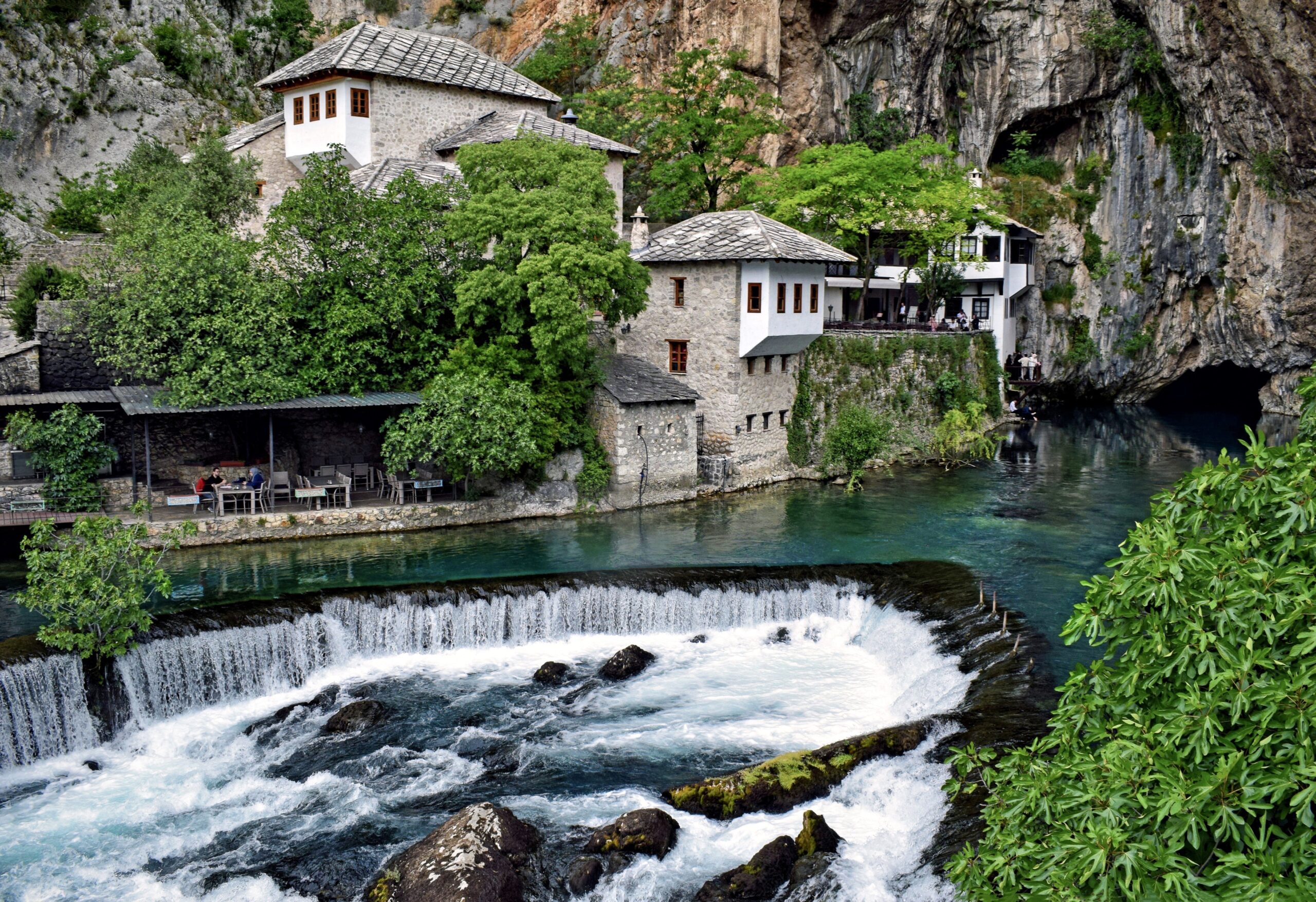
You hear Blagaj before you see it. The Buna river emerges from a cave at the foot of a two hundred meter limestone cliff at a rate of roughly forty cubic meters per second, which makes it one of the strongest karst springs in Europe, and the noise carries down the whole valley. Then you round the last bend and there is a small white Ottoman house sitting directly against the cliff face, right at the waterline, looking like it was set down there by hand.
That house is the tekke, a Sufi dervish lodge built around 1520. It is still a functioning religious building, not a museum piece, which is worth keeping in mind before you go.
What It Costs and What to Wear
Entry is 4 KM, paid at a small booth. There is a dress code and it is enforced politely but firmly: shoulders and knees covered for everyone, and women are given a headscarf at the door. Shoes come off before you go inside. Wraps and scarves are provided free if you turn up in shorts, so nobody gets turned away, but we felt better having brought our own.
Inside it is small. Really small. Low ceilings, dark carved wood, a few rooms of rugs and calligraphy, a room where the dervishes held their ceremonies, and a wooden balcony overhanging the water where the spray comes up at you. Twenty minutes covers it comfortably. The building is not the reason you stay for three hours.
The Part Everyone Skips
Almost every visitor photographs the tekke from the riverside path, buys a coffee, and leaves. Two things are worth doing instead.
The first is the boat. Small wooden boats run from just below the tekke into the mouth of the cave itself for about 10 KM per person. It takes ten minutes, the boatman kills the engine inside, and the temperature drops about eight degrees. You are floating inside the mountain that the river comes out of. It is the single best ten minutes in Herzegovina.
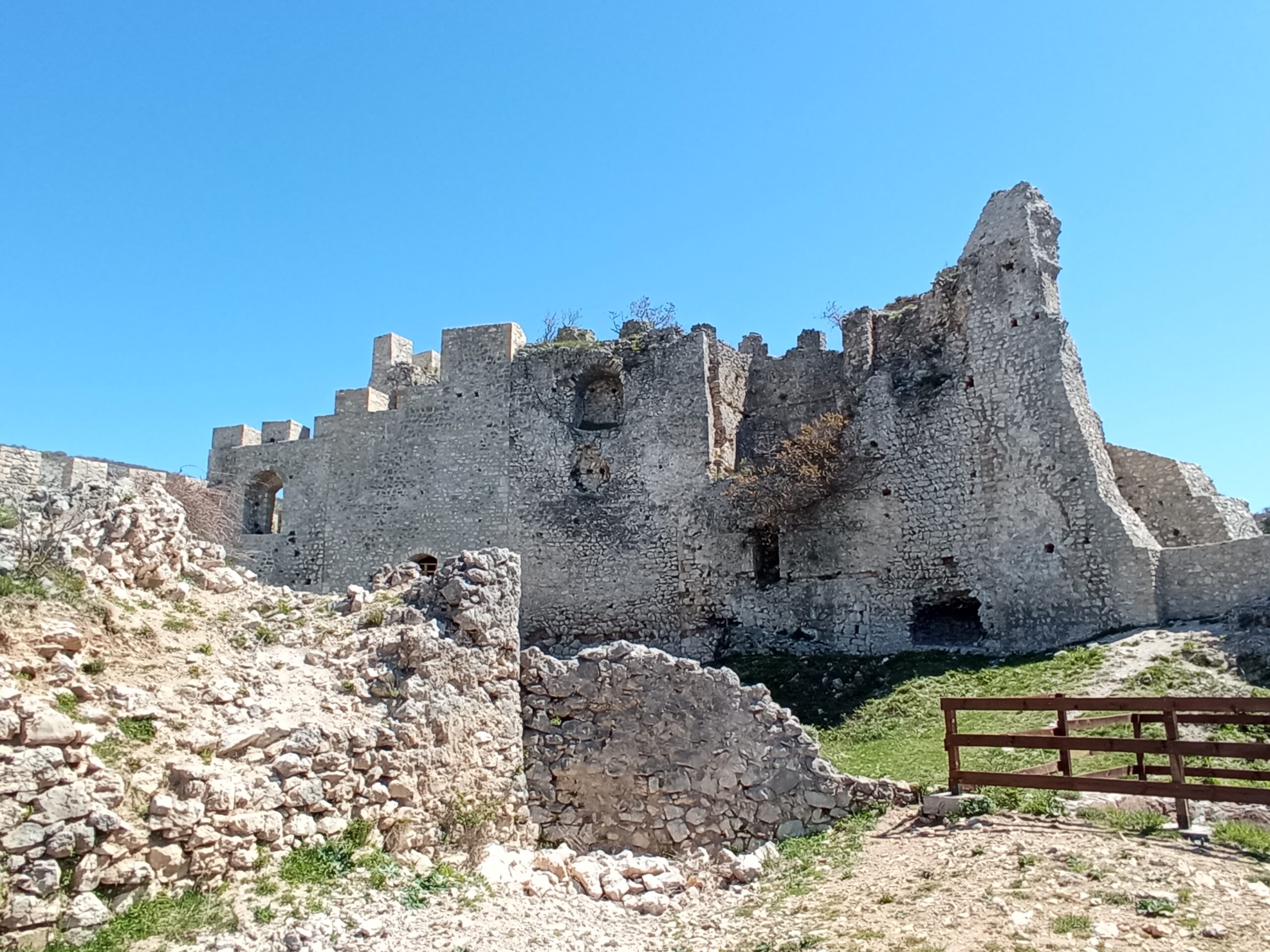
The second is the walk up to the Blagaj fortress, called Stjepan grad, on the ridge above. It is a steep, rocky, unshaded forty five minutes each way and there is no railing worth the name at the top, so skip it in July heat or with small kids. But the fortress is a genuine medieval ruin, the last seat of the Herzegovinian dukes, and you get the whole Buna valley laid out below with the tekke as a white dot against the cliff. We had it entirely to ourselves on a Tuesday morning in May while forty people milled around the tekke below.
Lunch at Blagaj
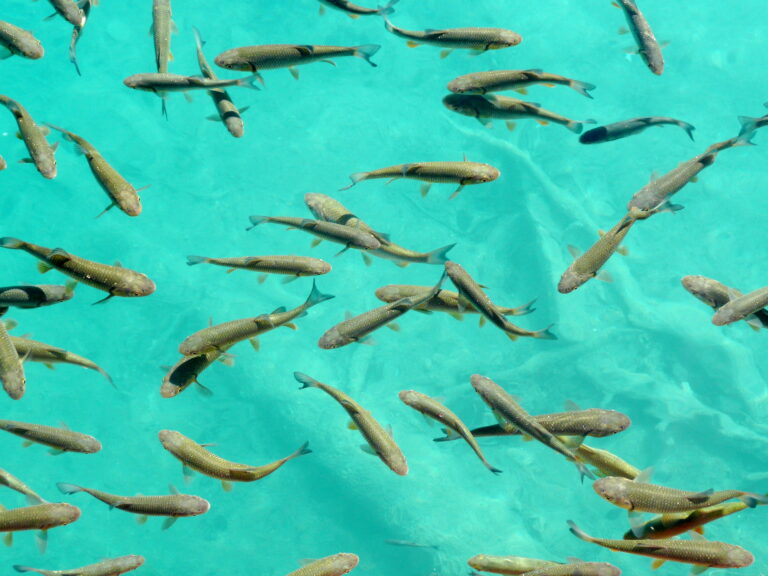
This is where we tell you to do what the guesthouse owner told us. There are several restaurants built out over the Buna on wooden decks, close enough to the spring that the water is genuinely cold beside you. Order the trout. It is farmed in the river right there, it is grilled whole with garlic and lemon, and it costs a fraction of what the equivalent would cost across the border in Croatia. Restoran Vrelo and Blagaj Tekija are the two obvious ones and both are good. Expect 15 to 25 KM for a full meal.
If you have been pricing out the region, this is the kind of thing that makes the numbers work. We go into the full breakdown in our guide to how much a trip to Bosnia and Herzegovina costs, but the short version is that a riverside trout lunch in Blagaj runs about a third of a comparable meal in Dubrovnik.
Kravice Waterfalls: Plan for Swimming, Not Photos
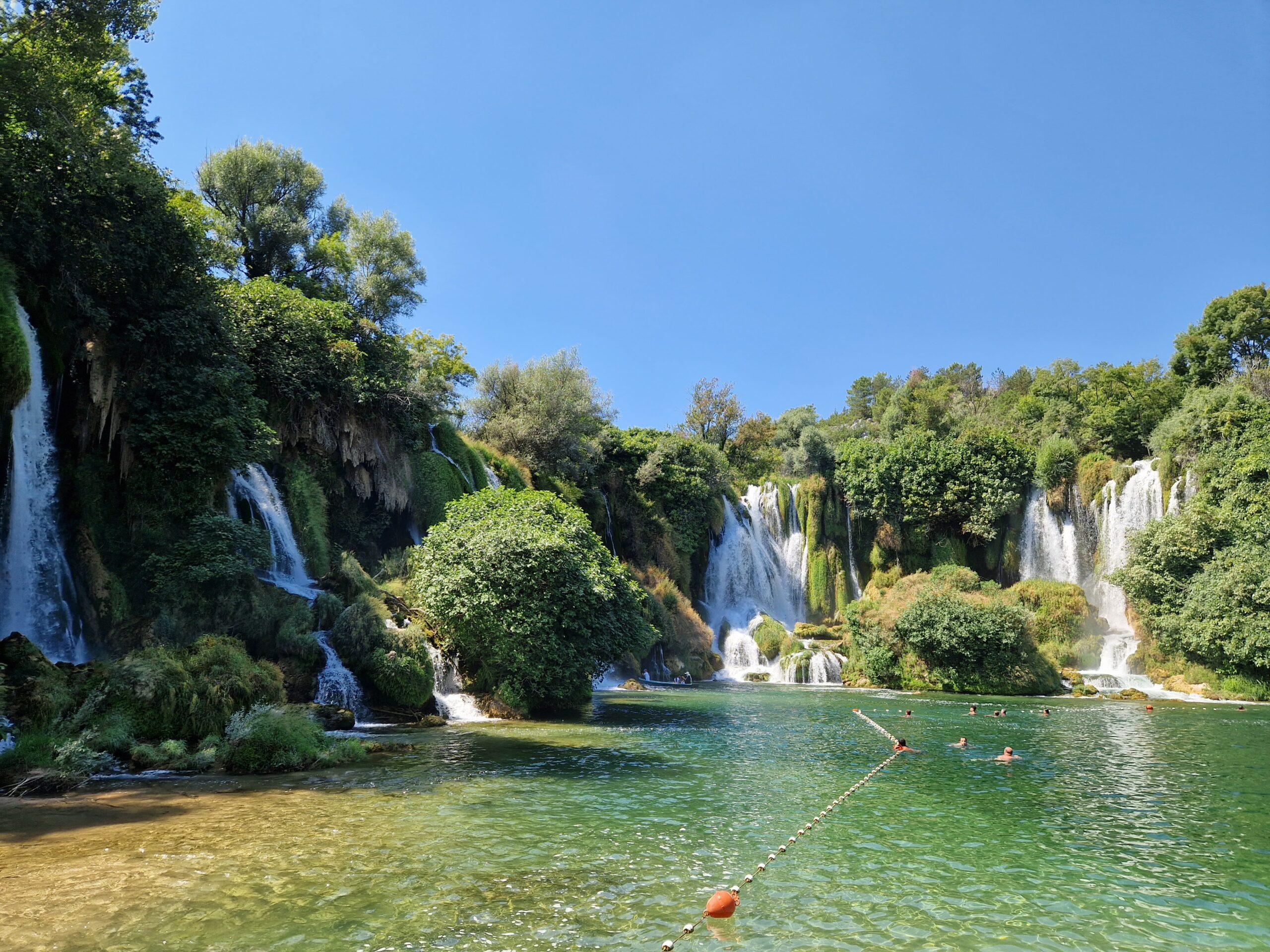
Kravice is a crescent of about twenty five waterfalls dropping roughly twenty five meters off a tufa barrier on the Trebizat river into a wide green pool. In high water it is a continuous curtain across a hundred and twenty meters. In August it thins out into separate ribbons, which is less dramatic but much better for swimming because the current calms down.
It is a nature park, not a wilderness. There is a car park at the top, a paved path and a set of stairs down, a couple of cafes and a small beach at the bottom, kayak and paddle boat rental, and in summer a train style shuttle for anyone who does not want the walk back up. None of that ruins it. It does mean you should adjust your expectations away from a remote hidden waterfall and toward a very good river swimming spot with a spectacular backdrop.
Getting In and Getting Down
Entry is 20 KM in peak season (roughly May through September) and 10 KM outside it. Bring cash in convertible marks, because the card machine has a habit of not working.
From the car park it is a ten to fifteen minute walk down, partly on a paved switchback road and partly on stairs. It is not difficult going down. Coming back up in thirty five degree heat after swimming is a different proposition, and the shuttle (a few KM) is money well spent if you are travelling with anyone who will not enjoy it.
Swimming, Honestly
The water is cold. Not Adriatic cold, properly cold, somewhere around fifteen to eighteen degrees even in August, because it is spring fed. You acclimatize in about ninety seconds and then it is wonderful.
The pool is large and mostly shallow at the edges, with a deeper channel in the middle where the falls land. You can swim right up to the base of the main falls, and being under the spray with the noise going is the whole reason to come. The rocks are slick with algae in places, so water shoes are a genuinely good idea rather than an over-preparation.
Two practical notes. There are changing cabins and toilets but they are basic and there can be a queue, so wear your swimsuit under your clothes. And the beach is pebble and rock, not sand, so bring something to sit on.
The Timing Trick
Here is the thing almost nobody gets right. Kravice faces roughly north, tucked into a bowl, and the falls sit in shadow for much of the morning. Tour buses from Mostar, Split and Dubrovnik arrive in a wave between about 10am and 1pm, which is exactly when the water is coldest, the light is flat and the pool is busiest.
Come at 3pm or later instead. The buses are leaving, the sun has been on the water for hours, the light is coming across the falls rather than at them, and you will have something close to the place to yourself by five. In shoulder season it closes earlier, so check, but in July and August you can stay until seven.
That is why Blagaj goes first in the day and Kravice second. It is not about distance. It is about light and crowds.
How to Get to Both Without a Tour
You have three options, and the right one depends on how much you value your own schedule.
Rent a car. This is what we did and what we would do again. Both sites have free or cheap parking, the roads are good, and the drive between Blagaj and Kravice takes about fifty minutes through open Herzegovinian countryside with vineyards and limestone. Petrol is inexpensive by Western European standards. If you are already planning a longer loop, our Bosnia and Herzegovina road trip itinerary folds both of these in without a detour.
Taxi or private driver. A round trip to Blagaj is cheap, often 25 to 35 KM each way. A half day driver covering both, with waiting time, typically runs 120 to 180 KM for the car, which split between three or four people beats a per person tour and leaves you in control of when you leave. Agree the price and the waiting time before you get in.
Public bus. Blagaj is easy: local buses run from Mostar regularly and cost a couple of marks. Kravice is not realistically doable by public transport. There is no direct service, and what exists leaves you a long walk from the entrance. If you do not have a car, take a tour or a driver for Kravice.
We would gently steer you away from the standard group tour that does Blagaj, Kravice, Pocitelj and sometimes Medjugorje in one day. It sounds like value. In practice it is forty minutes at each stop, you arrive at Kravice at the worst possible hour, and you swim in a crowd. If you want the multi-stop version, our guide to the best day trips from Mostar lays out which combinations actually work.
When to Go
Late May, June and September are the sweet spot. The Trebizat still has real volume at Kravice, the Buna is running hard at Blagaj, it is warm enough to swim, and the July and August crowds have not arrived or have gone.
April and early May give you the most dramatic water at Kravice, genuinely thunderous, but it is often too cold and too fast to swim, and the swimming area may be closed. July and August are hot, around thirty five degrees in the Neretva valley, with the thinnest waterfall flow and the biggest crowds, though the swimming itself is at its most pleasant. October through March, Kravice is quiet and often free or reduced, and Blagaj is atmospheric in a completely different way with mist coming off the spring, but you are not getting in the water. Our best time to visit Bosnia and Herzegovina guide has the month by month detail.
Where to Book
Most people base themselves in Mostar and day trip out, which is what we would recommend. Mostar has the best range of places to stay and you are twenty minutes from Blagaj.
- Hotels and guesthouses: Search Mostar stays on Booking.com. Family run guesthouses in the old town are the best value in the country, and several are a short walk from the Old Bridge. If you want something different, there are a handful of small guesthouses in Blagaj itself, right along the Buna, which are lovely and very quiet at night.
- Tours and transfers: Browse Blagaj and Kravice tours on Viator. If you are going to take an organised trip, look specifically for a small group or private option that gives you at least two hours at Kravice, and read the timings before you book.
- Car rental: Picking up in Mostar or Sarajevo is straightforward. Confirm the cross border card if you are also driving in Croatia or Montenegro.
What We Would Do Differently
Two things. We would have brought water shoes to Kravice instead of picking our way across the rocks like a couple of flamingos. And we would have skipped the fortress hike at Blagaj in the middle of the day and gone up at eight in the morning instead, when there is still shade on the path and the valley is full of mist off the spring.
Everything else we would repeat exactly: tekke first, boat into the cave, trout on the deck, then a slow drive out to Kravice for a long late afternoon in the water. It is the best single day in Herzegovina and it costs less than a nice dinner back home.
Planning more of Bosnia and Herzegovina? Start with our full Mostar travel guide for the town itself, then read how to plan a trip to Bosnia and Herzegovina for the practical groundwork on visas, money and driving. If you are coming across the border for the day, the best day trips from Dubrovnik explains what is actually achievable in the time you have.